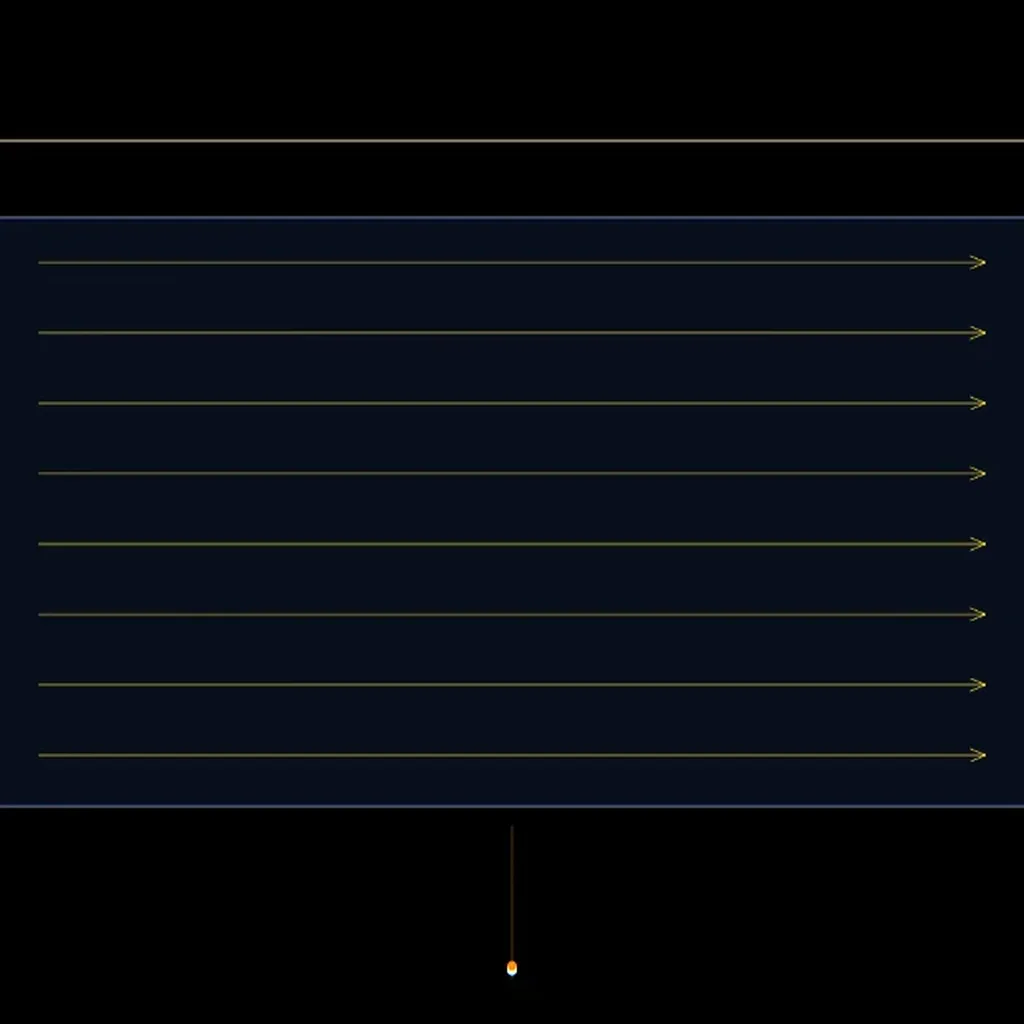
This simulation needs WebAssembly, and it could not start in this browser.
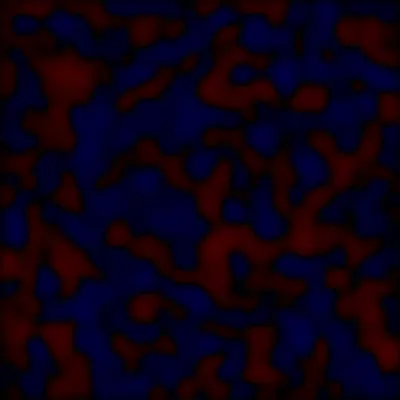
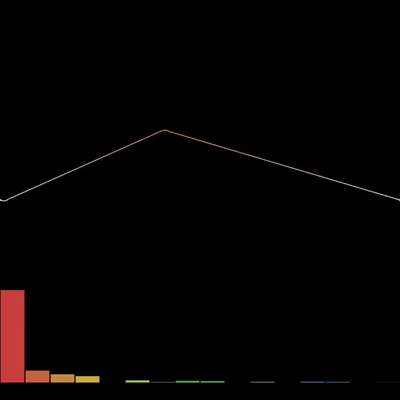
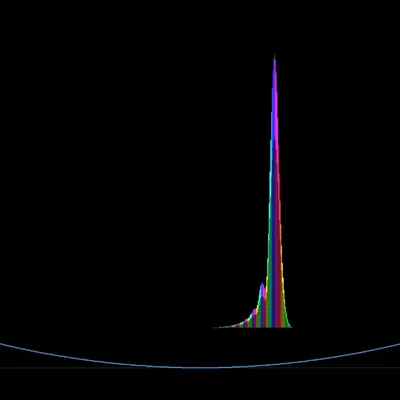
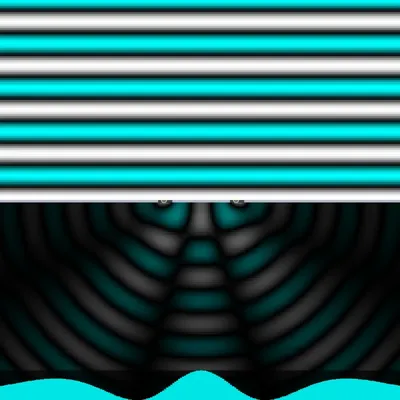
The image is a frame from a real run. Check that JavaScript is on, or try another browser.
Crossed electric and magnetic fields sort charged particles by speed. J. J. Thomson used the trick in 1897: he adjusted the two fields until their deflections of a cathode ray cancelled, read off the speed of the electrons as , and from that their charge to mass ratio. A year later Wilhelm Wien deflected beams of positive ions, the canal rays, with electric and magnetic fields and found charge to mass ratios close to that of the hydrogen ion, nearly two thousand times smaller than for electrons. The velocity selector built on this principle carries his name, and Wien filters still pick out ions or electrons of one speed in mass spectrometers, ion beam lines and electron microscopes.
What you see
A bunch of particles starts at the bottom of the canvas, all from the same point and moving straight up, each with a different speed. Between the two horizontal lines lies the filter, 460 pixels tall, with an electric field pointing to the right (the yellow arrows) and a magnetic field pointing into the screen (the crosses). Outside it the particles move in straight lines. The line near the top marks a detector. Each particle is colored by its speed relative to the selected speed : blue for slower, red for faster, green close to it. When every particle of a bunch has left the canvas, the next bunch starts. Each frame advances the motion by four steps of 1/240 s, so at the default speed setting one second of simulated time takes one second.
Governing equation
The Lorentz force with charge to mass ratio gives
For a particle moving straight up at speed , the electric force pushes it right with strength and the magnetic force pushes it left with strength . They cancel when
so that particle crosses the filter without turning. Any other particle moves as the sum of two motions: a drift straight up at and a circle of radius traversed with angular frequency . Faster particles circle to the left, slower ones to the right. At the default fields and the selected particle needs 2.3 s to cross the filter, a good third of the 6.3 s it takes to complete a circle, so the sideways displacement , with , is well beyond the small angle limit where it would grow in proportion to . A particle faster than about completes a loop before it gets far and leaves the filter again through the entrance.
Presets
All four presets use and , so pixels per second.
Matched beam: 15 particles with speeds from 100 to 300, centered on . The particle at 200 reaches the detector after 3.3 s exactly above its starting point. The fastest one arrives after 2.6 s, 159 pixels to the left; the slowest after 4.1 s, 196 pixels to the right. A new bunch starts every 4.7 s.
Narrow beam: 20 particles from 180 to 220 pixels per second. A spread of 20% in speed becomes a fan 76 pixels wide at the detector. A new bunch starts every 4.2 s.
Wide spread: 30 particles from 20 to 380 pixels per second. The slowest particle needs 9.4 s to reach the detector and lands 357 pixels to the right; the deflection of the fastest ones levels off about 200 pixels to the left, because they spend less time in the filter. A new bunch starts every 9.8 s.
Detuned beam: 15 particles from 210 to 390 pixels per second, all faster than . The whole fan lands to the left of center, between 19 and 202 pixels off. A new bunch starts every 4.1 s.
Parameters
Distances are in pixels and times in seconds, so speeds are in pixels per second, in pixels per second squared and in radians per second.
Electric field E: from 50 to 500. Acts at once, also on particles already in flight.
Magnetic field B: from 0.1 to 3. Acts at once. Together with Electric field E it sets the selected speed and the angular frequency of the circling motion.
Beam speed v₀ (pixels per second): the center of the speed range, from 50 to 500. Applies on Reset.
Speed spread: the half width of the speed range as a fraction of the beam speed, from 0 to 1. The speeds are evenly spaced between and , but never below . Applies on Reset.
Particles per bunch: from 2 to 40. Applies on Reset.