This simulation needs WebAssembly, and it could not start in this browser.
The image is a frame from a real run. Check that JavaScript is on, or try another browser.
Peter Clifford and Aidan Sudbury introduced this model in 1973 as a picture of two species competing for territory, and Richard Holley and Thomas Liggett named it the voter model in 1975. It is about the simplest model of social influence there is: every voter holds one of two opinions and, from time to time, adopts the opinion of a randomly chosen neighbor. There is no energy, no majority rule and no conviction, only imitation. Even so, the opinions form growing domains, and on a finite grid one opinion eventually wins everywhere. The model has become a standard reference point in probability theory and statistical physics because many of its properties can be computed exactly. A small rate of spontaneous opinion changes, or a few voters who never change their mind, is enough to stop it from ever reaching consensus.
What you see
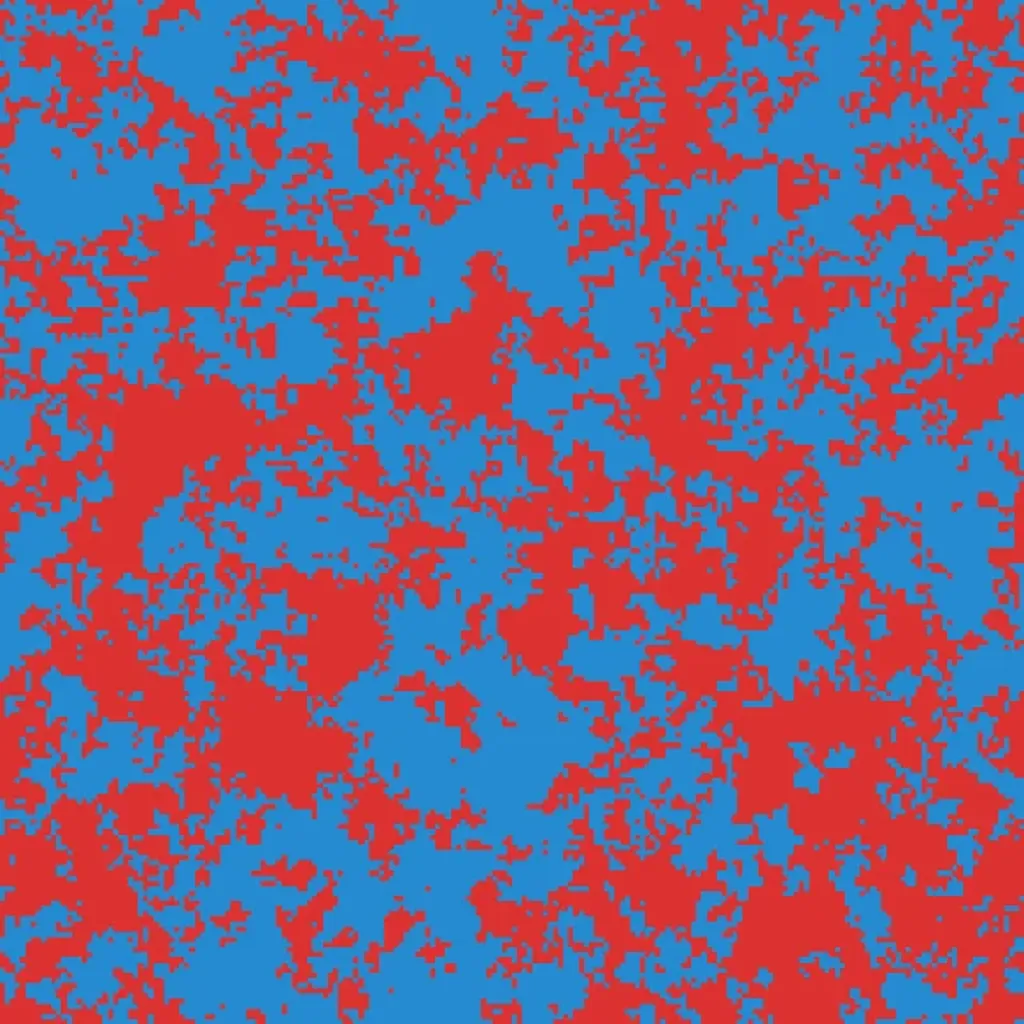
A 200 by 200 grid whose edges wrap around, so the grid is a torus. Each cell is a voter: blue for one opinion, red for the other. Dark blue and dark red cells are zealots, voters who never change their opinion. Every run starts from a random half-and-half mix. In the panel, Grid entropy H shows the Shannon entropy of the cell states: 1 bit for an even split of the opinions and 0 at consensus. Zealots count as two further states, so with zealots the value is higher.
Rule
Each step makes updates, so every voter is updated once per step on average. An update picks a voter at random. Zealots are skipped. Otherwise, with probability the voter switches to the other opinion, and with probability it copies one of its four nearest neighbors (up, down, left, right), chosen at random. A voter with neighbors of the other opinion therefore changes its opinion with probability
Copying does not change the expected fraction of either opinion, so without noise the fraction performs an unbiased random walk. Noise pulls it back towards one half: a deviation from an even split decays on average as , with in steps, so the opinion fraction forgets its past after about steps.
Without noise, consensus is an absorbing state: once every voter holds the same opinion, nothing changes again. In two dimensions the voter model sits at a borderline. The domains grow, but their boundaries stay rough and the density of boundaries between neighbors of different opinion decays only as . On a grid of voters, the mean time to consensus grows as steps.
Presets
No noise (slow consensus): . The share of neighbor pairs that disagree drops from 0.5 to 0.38 in the first step, to 0.19 after 100 steps and to 0.14 after 1000 steps, and then hardly at all: it stays between 0.11 and 0.14 up to 100 000 steps. Meanwhile the opinion fraction drifts far from one half. The random numbers are the same after every reset, so the run repeats exactly: the grid reaches consensus after about 172 000 steps, about 48 minutes at normal speed (60 steps per second). For other random starts the consensus time varies widely.
Low noise (large domains): . The domains stay large, but no opinion can take over: the red fraction stays between 0.41 and 0.59, with a standard deviation of 0.03, and changes on a time scale of several hundred steps, close to .
Strong noise (no consensus): , the right end of the slider. Domains stay small and short-lived. The red fraction stays between 0.47 and 0.53 and forgets its past within about 25 steps, as predicts.
Zealots (5%): , and 5% of the voters, chosen at random from both opinions, are zealots. Each zealot keeps converting the voters around it, so both opinions keep a foothold everywhere. The red fraction stays close to one half, between 0.45 and 0.54, and the domains stay smaller than with noise alone.
Parameters
Noise rate η: the probability that an updated voter switches opinion spontaneously, 0 to 0.02. It applies immediately.
Zealot fraction: the share of voters that never change their opinion, 0 to 0.2, taken equally from both opinions on average. It applies when the simulation is reset.