This simulation needs WebAssembly, and it could not start in this browser.
The image is a frame from a real run. Check that JavaScript is on, or try another browser.
René Thomas, a Belgian biologist known for his work on the logic of gene regulatory networks, published this system in 1999 to show how chaos can arise from feedback circuits. Each variable is driven by the sine of the next one and slowed by a friction , and the three are linked in a single loop. Because the sine is periodic, the system has many fixed points spread through space instead of one or two, more of them the smaller is, and its behavior changes in stages as the friction is lowered.
What you see
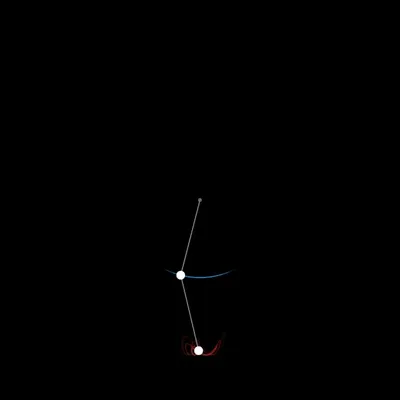
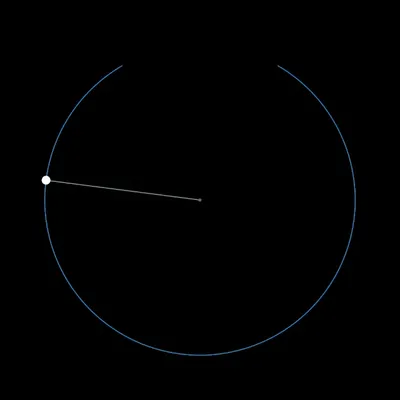
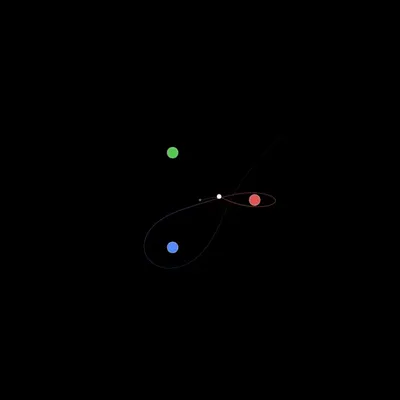
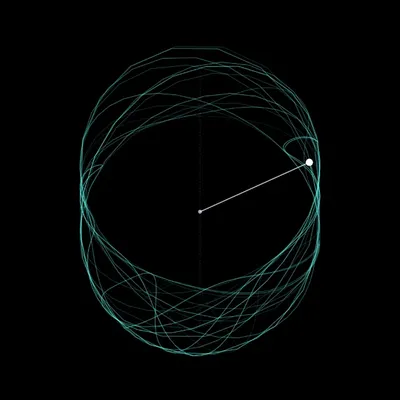
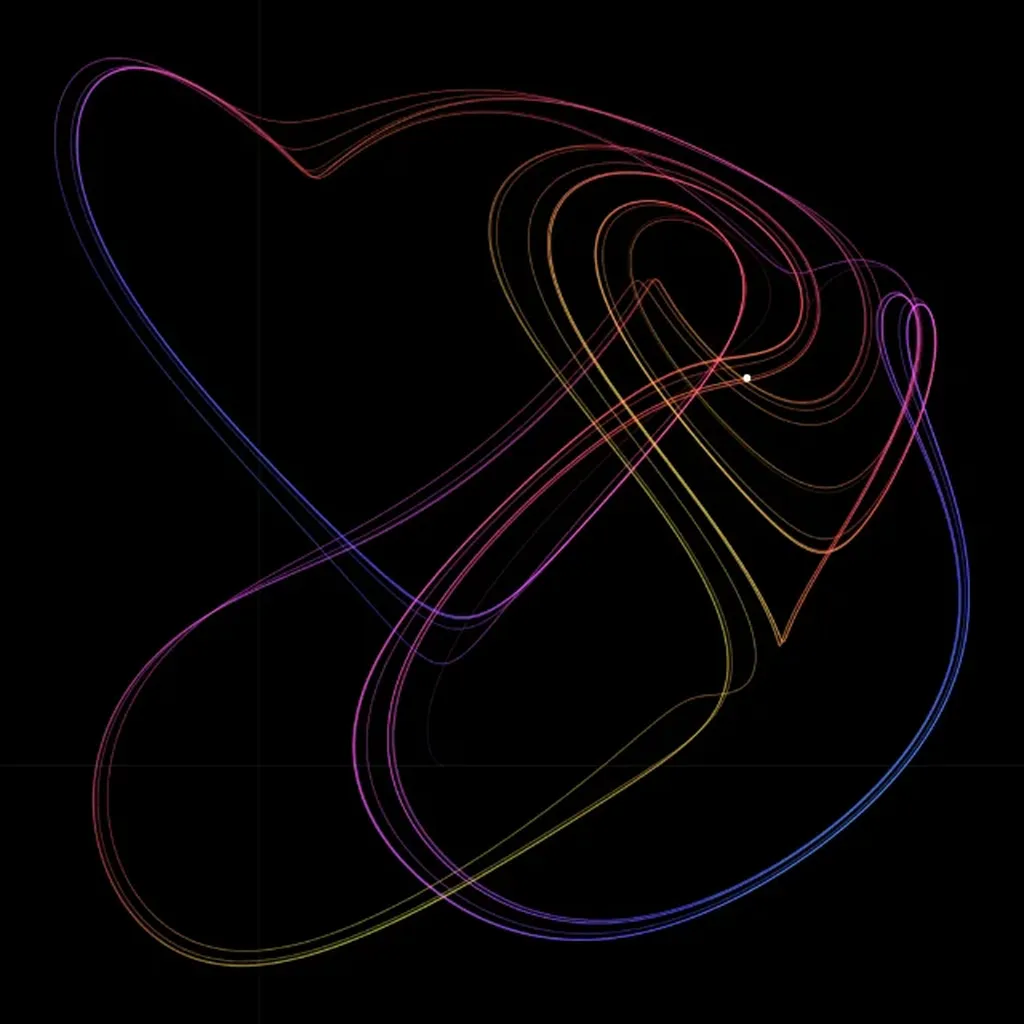
The trajectory starts at and is projected onto the x-y plane. Its color shows , scaled to the range the trail covers, the white dot is the current position, and the current and are printed in the corner. The view follows the trajectory with the same scale on both axes: it widens at once when the orbit reaches its edge and narrows slowly when the orbit occupies less. Integration uses fourth-order Runge-Kutta by default, each step of split into four substeps, with eight steps per frame.
Canonical chaos (b=0.208): the chaotic regime near . The chaos is weak and the attractor sits off center, between about and in each coordinate. Its mirror image through the origin is a second attractor of the same system.
Labyrinth chaos (b=0.05): with little friction the orbit wanders far through the lattice of fixed points, out to about in each coordinate, in an irregular way that looks like a random walk. The chaos is much stronger than at 0.208, with a largest Lyapunov exponent of about 0.12. In the limit the walk becomes unbounded.
Periodic orbit (b=0.32): just below the Hopf bifurcation at . The orbit is a small loop around the fixed point on the diagonal at .
Limit cycle (b=0.22): between the Hopf bifurcation and the onset of chaos, the motion is periodic.
Governing equation
The system is unchanged by the cyclic swap and by the reflection . The divergence is everywhere. For the origin is the only fixed point and it attracts everything. At it splits into two stable fixed points; these lose stability in a Hopf bifurcation near , and the limit cycle born there goes through period doublings to chaos near . At there is no friction at all, the fixed points sit on a cubic lattice at multiples of , and the motion is conservative.
Parameters
b (dissipation): 0.05 to 0.5, default 0.208. The friction acting on each variable, and the only parameter.
Time step dt: 0.01 to 0.1, default 0.05.