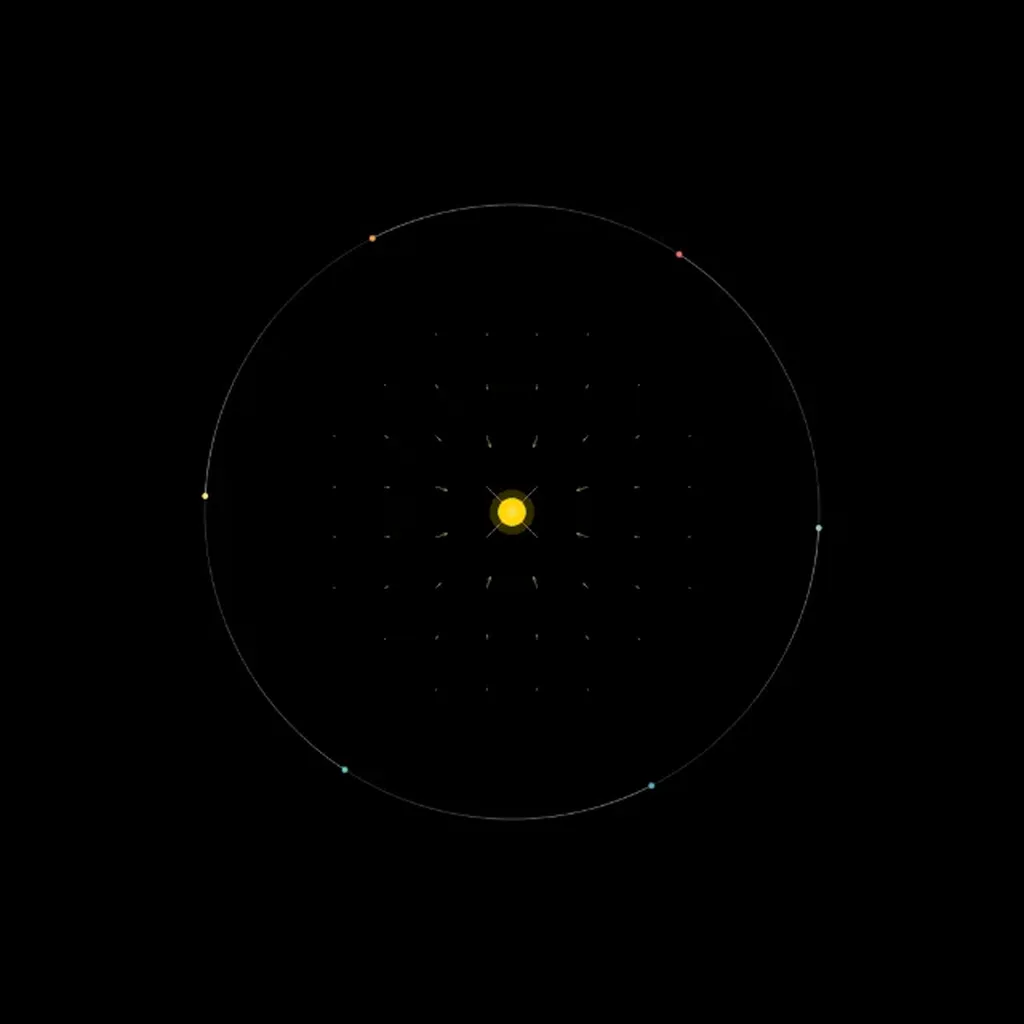
This simulation needs WebAssembly, and it could not start in this browser.
The image is a frame from a real run. Check that JavaScript is on, or try another browser.
Put several satellites on the same elliptical orbit, each a rotated copy of the others, and start them all at periapsis at the same moment. The satellites are too light to disturb each other, and gravity has no preferred direction, so the arrangement stays symmetric: at every instant the satellites form a regular polygon. Navigation constellations apply the same idea in three dimensions; GPS was designed around 24 satellites in six orbital planes.
What you see
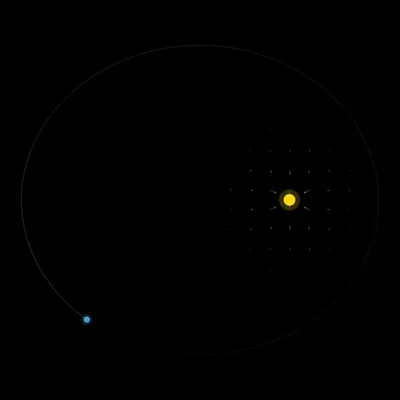
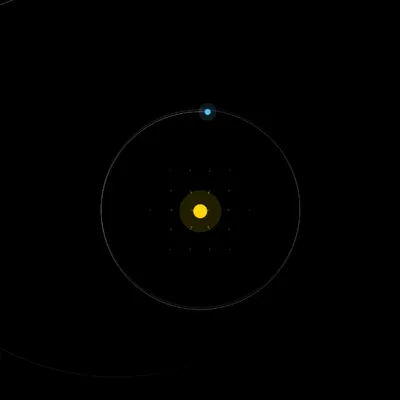
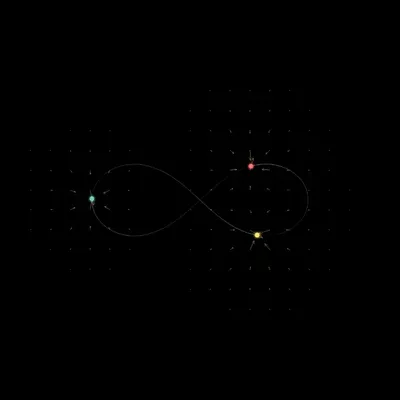
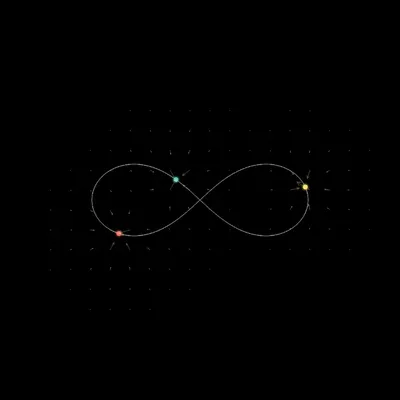
colored satellites orbit a star of mass 1, with . Every orbit has semi-major axis and the same eccentricity , and satellite starts at the periapsis of its own ellipse, rotated by from the first.
On circular orbits the polygon simply turns at constant speed. On elliptical orbits it breathes: it shrinks to radius and spins quickly through periapsis, then grows to and turns slowly at apoapsis. This is Kepler’s second law, acting on all satellites at once. The trails trace rotated copies of the ellipse, a rosette that leaves an empty disk of radius around the star. The view reaches 2.5 units from the star, or farther when the apoapsis lies beyond that, so every orbit stays whole.
Governing equation
The satellites have mass , so each one moves in the field of the star alone:
Each starts at periapsis with the vis-viva speed
so every satellite has the period , whatever is. The equation does not change under a rotation about the star, so satellite at time is satellite 0 at time , rotated by .
Presets
6 circular orbits: a regular hexagon turning rigidly on one circle.
6 elliptical orbits (e=0.6): the hexagon pulses between radius 0.6 and 2.4, and the trails draw a six-petaled rosette.
20 satellites (crowded): twenty satellites evenly spaced on one circle, the most the slider allows.
8 high-eccentricity (e=0.85): an octagon that collapses to radius 0.225 at periapsis and swings out to 2.775 at apoapsis. The view widens to 3 units to hold it.
Parameters
Satellites: the number of satellites , 2 to 20 (default 6).
Eccentricity: shared by all orbits, 0 to 0.9 (default 0).
Time step dt: the integration step, 0.0005 to 0.04 (default 0.005). Steps per frame: 1 to 32 (default 8).
Integrator and Softening: leapfrog and by default.
The remaining controls change only the drawing.