This simulation needs WebAssembly, and it could not start in this browser.
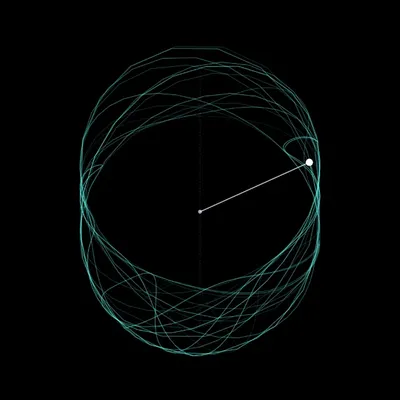
The image is a frame from a real run. Check that JavaScript is on, or try another browser.
In 1994 J. C. Sprott set a computer to search through three-variable flows with quadratic terms, looking for the algebraically simplest ones that are chaotic. He kept systems with five terms and two nonlinearities, or six terms and one, and reported nineteen of them, labeled A to S, in “Some simple chaotic flows” in Physical Review E. Case B has five terms, two of them quadratic, and no adjustable parameter at all: the constant in the last equation sets the only scale. (Case A turned out to be a system already known from physics, the Nosé-Hoover oscillator, which has its own page here.)
What you see
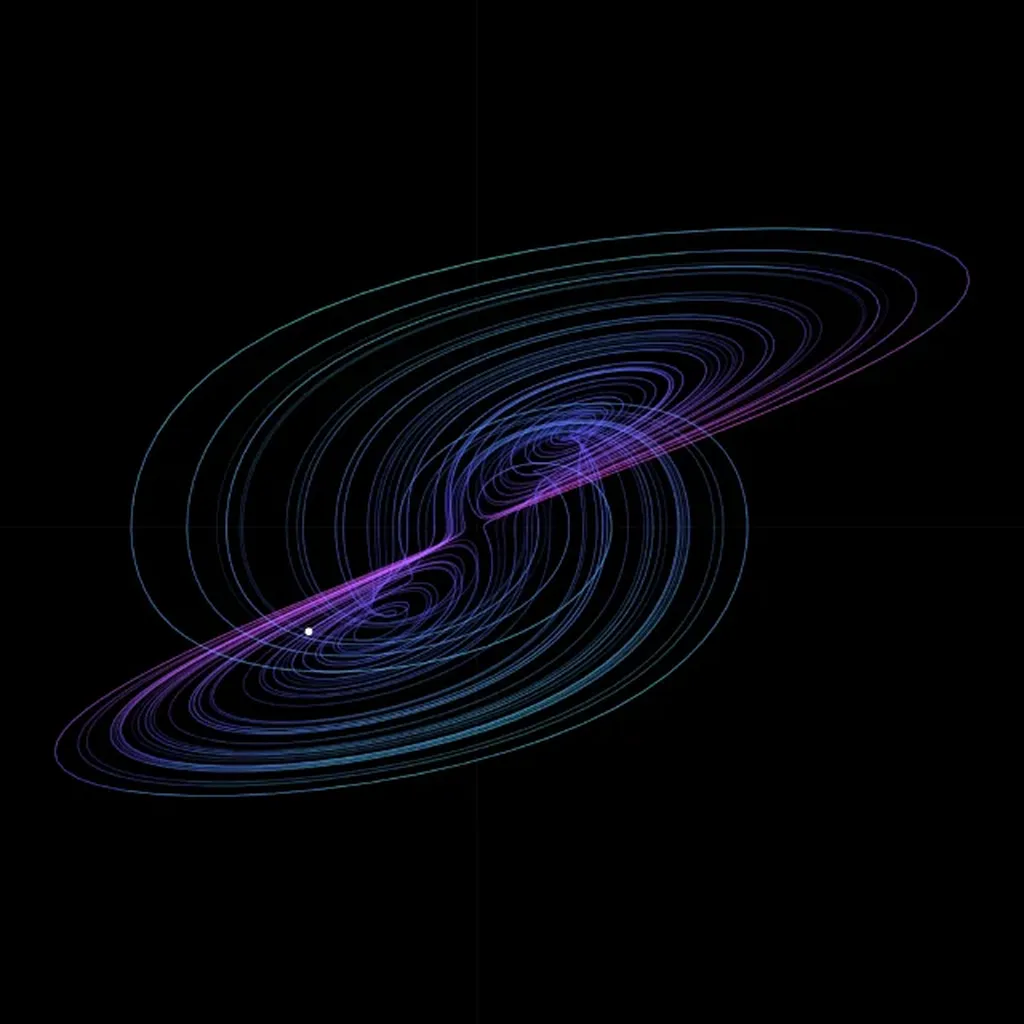
The trajectory is projected onto the x-y plane. Its color shows , from cyan (low) to magenta (high), scaled to the range the trail covers, the white dot is the current position, and the current , and are printed in the corner. The view follows the trajectory with the same scale on both axes: it widens at once when the orbit reaches its edge and narrows slowly when the orbit occupies less. Integration uses fourth-order Runge-Kutta by default, each step of split into four substeps, with eight steps per frame.
Classic Sprott B: starts at . After a short transient the orbit settles on the strange attractor and keeps tracing it.
Shifted IC: starts at . The transient looks different, but the orbit ends up on the same attractor.
Governing equation
The fixed points are and , and the system is unchanged by , which maps one to the other. Only the term removes volume, so the divergence is exactly everywhere. Sprott reported Lyapunov exponents of about , and , which add up to that divergence and give a Kaplan-Yorke dimension of .
Parameters
There is nothing to tune in the equations. Time step dt (0.01 to 0.1, default 0.05) sets the integration step, and Integrator selects the scheme, Runge-Kutta 4 by default.