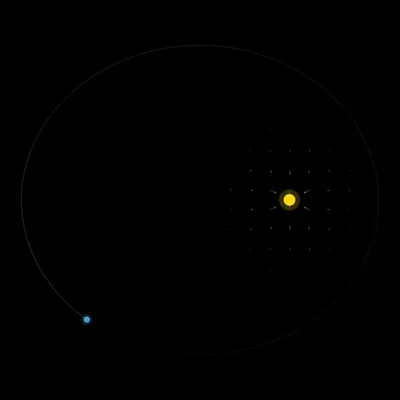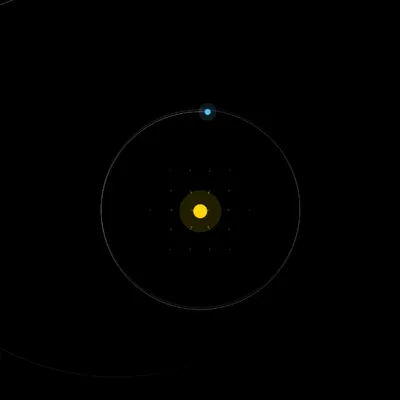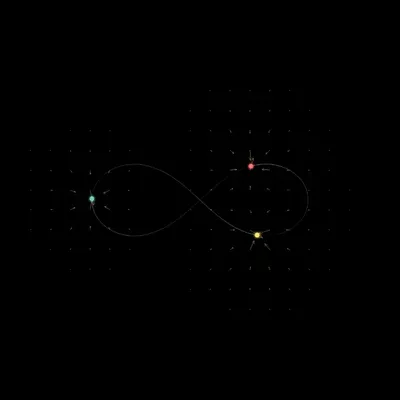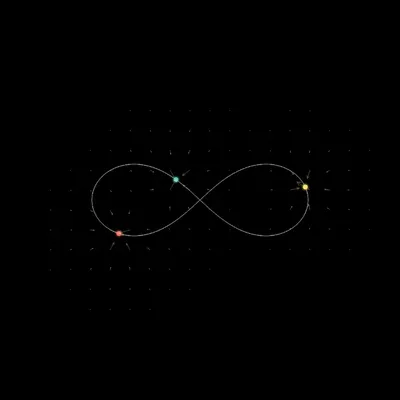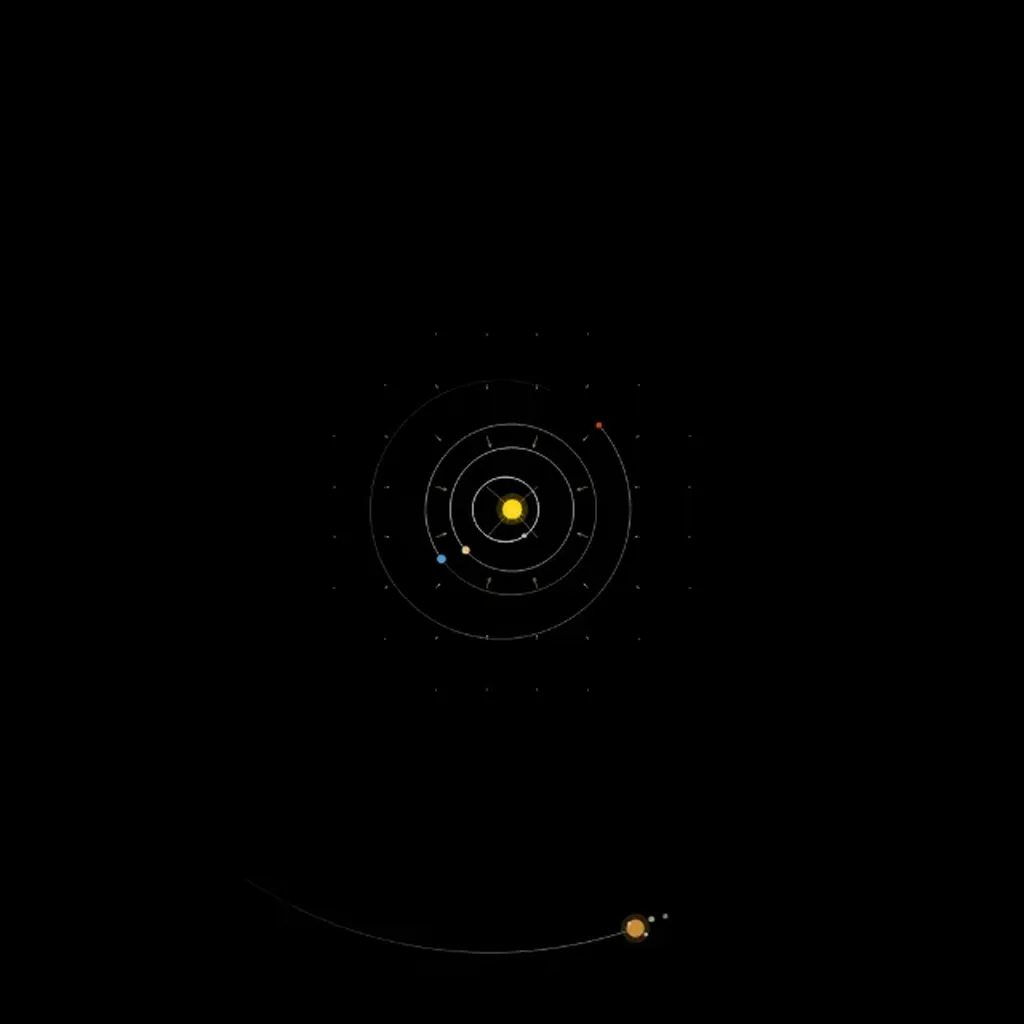
This simulation needs WebAssembly, and it could not start in this browser.
The image is a frame from a real run. Check that JavaScript is on, or try another browser.
The Solar System is the N-body problem we live in. This simulation follows the Sun, the five planets out to Jupiter and Jupiter’s four large moons, with real semi-major axes, eccentricities and masses, in astronomical units (AU) and years. In these units , and Kepler’s third law for a planet of negligible mass reads simply : the Earth’s period is 1 year, Jupiter’s 11.86 years.
What you see
The Sun sits at the center of a view 12 AU across. Mercury, Venus, Earth, Mars and Jupiter all start at perihelion, lined up on the horizontal axis to the right of the Sun, and soon spread out because the inner planets move much faster: Mercury goes around 4.15 times per Earth year. The planets’ trails show the last two years, one point every 0.005 yr.
Io, Europa, Ganymede and Callisto start on circular orbits around Jupiter at their true distances, drawn 30 times farther from Jupiter than they are. Their periods range from 1.8 days (Io) to 16.7 days (Callisto), and their masses are the real ones, from (Europa) to (Ganymede) solar masses. Io’s orbital frequency is per year, and leapfrog follows an orbit only while stays well below its stability limit of 2. The step is therefore yr, about two hours, which gives Io 19 steps per orbit (), and 32 steps make one frame of almost three days: an Earth year passes in about two seconds. Io completes more than an orbit per frame, so the inner moons seem to jump around Jupiter instead of circling it, and the moons draw no trails.
The preset With asteroid belt (Kirkwood gaps) adds 200 asteroids as gray dots. They are massless test particles on circular orbits at random angles, with semi-major axes spread uniformly between 2.2 and 3.2 AU, except within 0.04 AU of 2.50, 2.82 and 2.95 AU. Those are the 3:1, 5:2 and 7:3 mean-motion resonances with Jupiter, where Daniel Kirkwood pointed out gaps in the real belt in 1866. Here the gaps are put in by hand. In the real belt, Jupiter’s repeated pull at the same orbital phase made those orbits chaotic and cleared them over millions of years, far longer than this simulation runs.
Governing equation
summed over all bodies, with softening AU. Each planet starts at perihelion with the speed that the vis-viva equation gives there:
Mercury, with , changes its distance and speed the most along its orbit; Mars follows with .
Presets
Inner solar system: the Sun, five planets and four moons, with labels and trails.
With asteroid belt (Kirkwood gaps): adds the 200 asteroids described above and turns the trails off.
Long trails: the same system with the labels hidden and trails eight years long, so the paths stand out.
Parameters
Time step dt: the integration step in years, 0.0001 to 0.002 (default 0.00025), applied on Reset. Above about 0.0015 yr, where for Io passes 2, Io is thrown away from Jupiter. Steps per frame: 1 to 32 (default 32).
Asteroid belt: adds or removes the asteroids.
Integrator and Softening: leapfrog and AU by default.
The remaining controls change only the drawing.