This simulation needs WebAssembly, and it could not start in this browser.
The image is a frame from a real run. Check that JavaScript is on, or try another browser.
Smoke from a fire, steam from a cup and the plume of a chimney all rise for the same reason: the warm gas is lighter than the air around it. Buoyancy accelerates the plume, the plume drags surrounding air along (entrainment), and the shear at its edges curls up into eddies. In a closed room the smoke spreads under the ceiling and the smoky layer deepens downward: the “filling box” that Baines and Turner described in 1969.
What you see
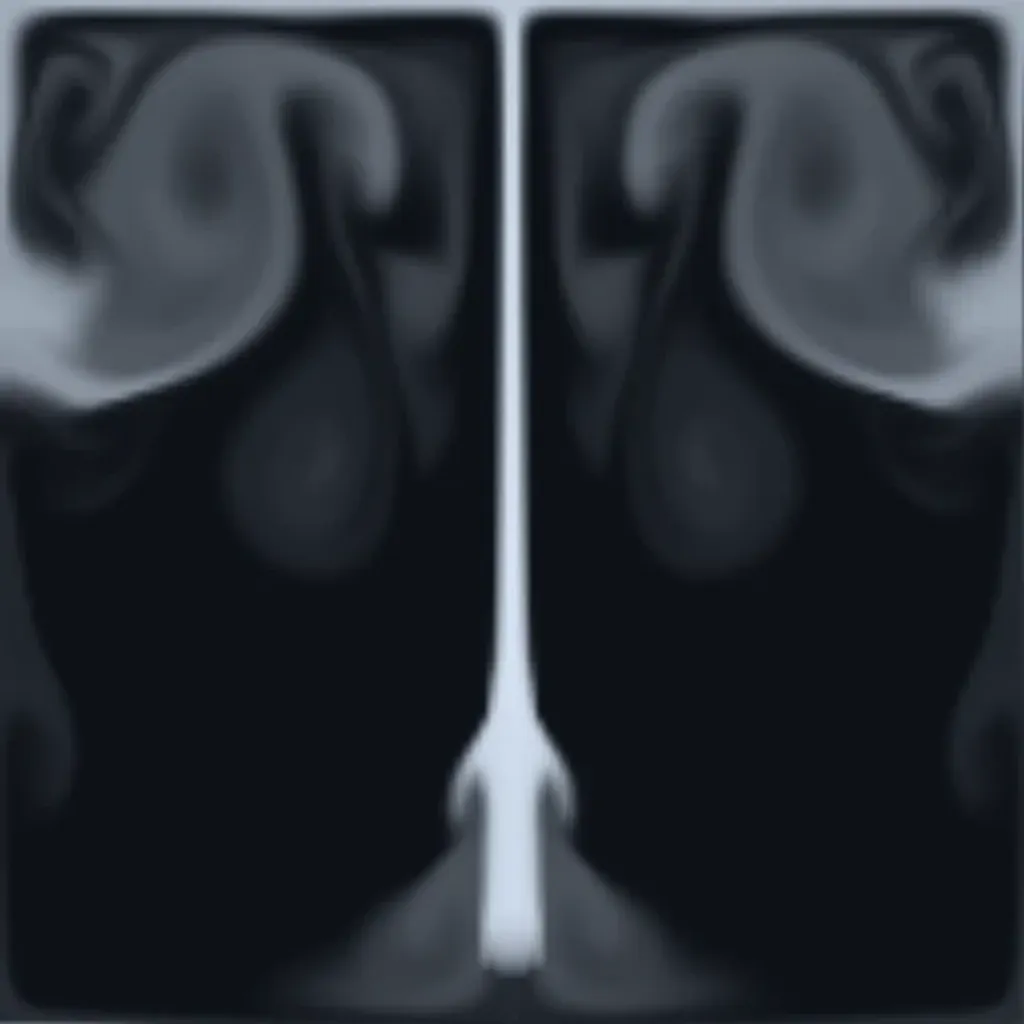
Smoke concentration, bright where the smoke is dense, in a square box that wraps around at the sides. A source just above the floor keeps releasing warm smoke. The plume starts as a narrow column with a rolled-up head, then wavers and sheds eddies as it rises. Under the ceiling it spreads sideways and the smoky layer grows down toward the source. Since the smoke never leaves the box, the box ends up full: press Reset to start over.
Equation
The smoke concentration is carried by an incompressible flow and makes the fluid buoyant (Boussinesq approximation, buoyancy ):
with the velocity from the streamfunction, , and a source that is nonzero only in a small disk above the floor. Floor and ceiling are free-slip.
Numerics
A 128 by 128 grid, streamfunction and vorticity at the cell corners, smoke at the cell centers. Vorticity is advected with Arakawa’s Jacobian and the smoke with a limited upwind flux, so smoke is never created or lost by the transport and never overshoots the range 0 to 1. Time advances with a three-stage Runge-Kutta scheme, and the Poisson equation is solved exactly with a Fourier transform sideways and a tridiagonal solve between floor and ceiling.
Presets
Rising plume: a steady source in the middle of the floor.
Puffs: the source switches on and off, and each puff rises as a thermal that rolls up into a vortex ring (seen in this slice as two counter-rotating eddies).
Two plumes: two sources side by side. Each plume draws in air from around it, so the two lean toward each other and merge.
Laminar plume: twenty times the viscosity: the plume rises as a smooth column with a mushroom head.
Parameters
Buoyancy β: 0.2 to 4. The plume’s speed grows with the square root. Applies live.
Viscosity ν: to , logarithmic. Applies live.