This simulation needs WebAssembly, and it could not start in this browser.
The image is a frame from a real run. Check that JavaScript is on, or try another browser.
Alastair Rucklidge derived this system in 1992, in a study of chaos in models of double convection, in which convection driven by heating is also shaped by a second effect such as a dissolved solute or a magnetic field. Its second equation, , makes it easy to read: is just the velocity of , and the system is a damped particle whose restoring force is set by a slow third variable , which in turn grows with .
What you see
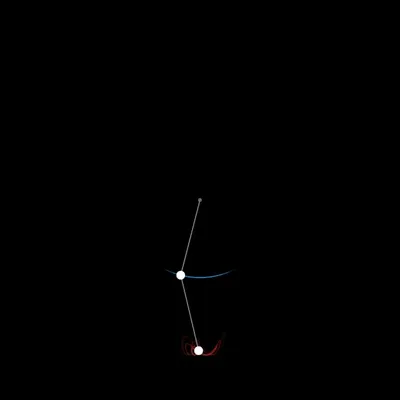
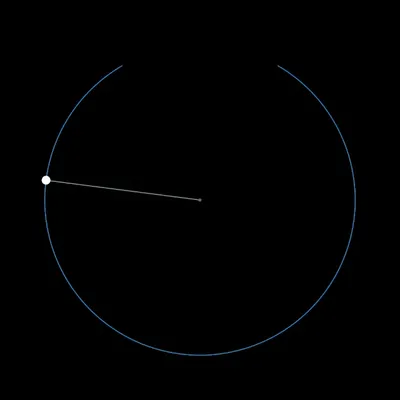
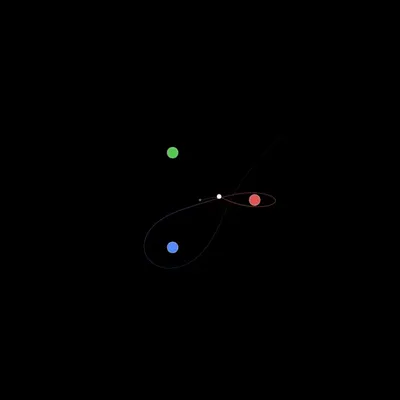
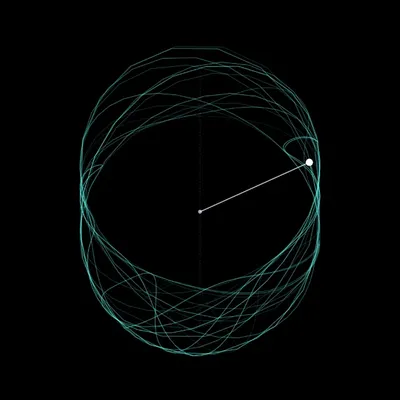
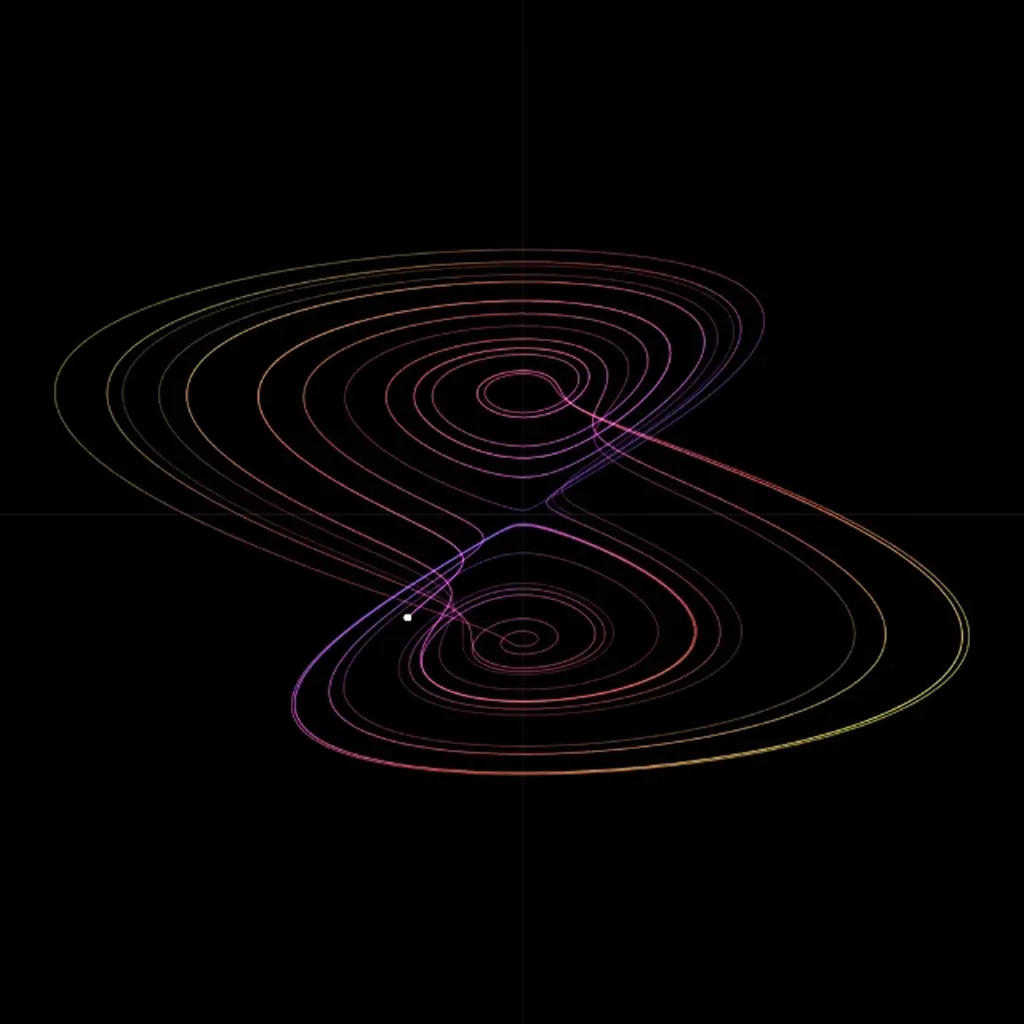
The trajectory starts at and is projected onto the x-y plane, which here is the phase portrait of with its velocity on the horizontal axis. Its color shows , scaled to the range the trail covers, the white dot is the current state, and the current is printed in the corner. The view follows the trajectory with the same scale on both axes: it widens at once when the orbit reaches its edge and narrows slowly when the orbit occupies less. Integration uses fourth-order Runge-Kutta by default, each step of split into four substeps, with eight steps per frame.
Canonical (κ=2, λ=6.7): the standard chaotic parameters. The orbit swings around one of two lobes, positive or negative , and jumps to the other at irregular times.
Strong coupling (λ=9): still chaotic, with a larger attractor and faster divergence of nearby orbits.
High damping (κ=3.5): the damping wins. The orbit spirals into the fixed point at , and stays there.
Near-periodic (κ=1, λ=5): the orbit settles on a periodic loop. The loop is not symmetric under , so its mirror image is a second periodic orbit.
Governing equation
Eliminating gives together with . While the origin is unstable and is pushed away from it; as grows, rises above , the force turns restoring, and swings back. The fixed points are the origin and . The system is unchanged by , which is why the two lobes match, and its divergence is everywhere.
Parameters
κ (damping): 0.5 to 4, default 2. Damping of , the velocity of .
λ (coupling): 3 to 12, default 6.7. The destabilizing linear push on , and the level has to reach before the force turns restoring.
Time step dt: 0.002 to 0.025, default 0.01.