This simulation needs WebAssembly, and it could not start in this browser.
The image is a frame from a real run. Check that JavaScript is on, or try another browser.
In 1976 Otto Rössler, working in Tübingen, published a chaotic flow that was meant to be simpler than Lorenz’s. The Lorenz equations need two quadratic terms; Rössler’s get by with one, the product . The result is the easiest strange attractor to understand by eye: a trajectory spirals outward in the x-y plane, is lifted steeply in once passes , and drops back near the center, folded over onto the spiral it came from. Stretching by the spiral and folding by the lift are the whole mechanism of the chaos.
What you see
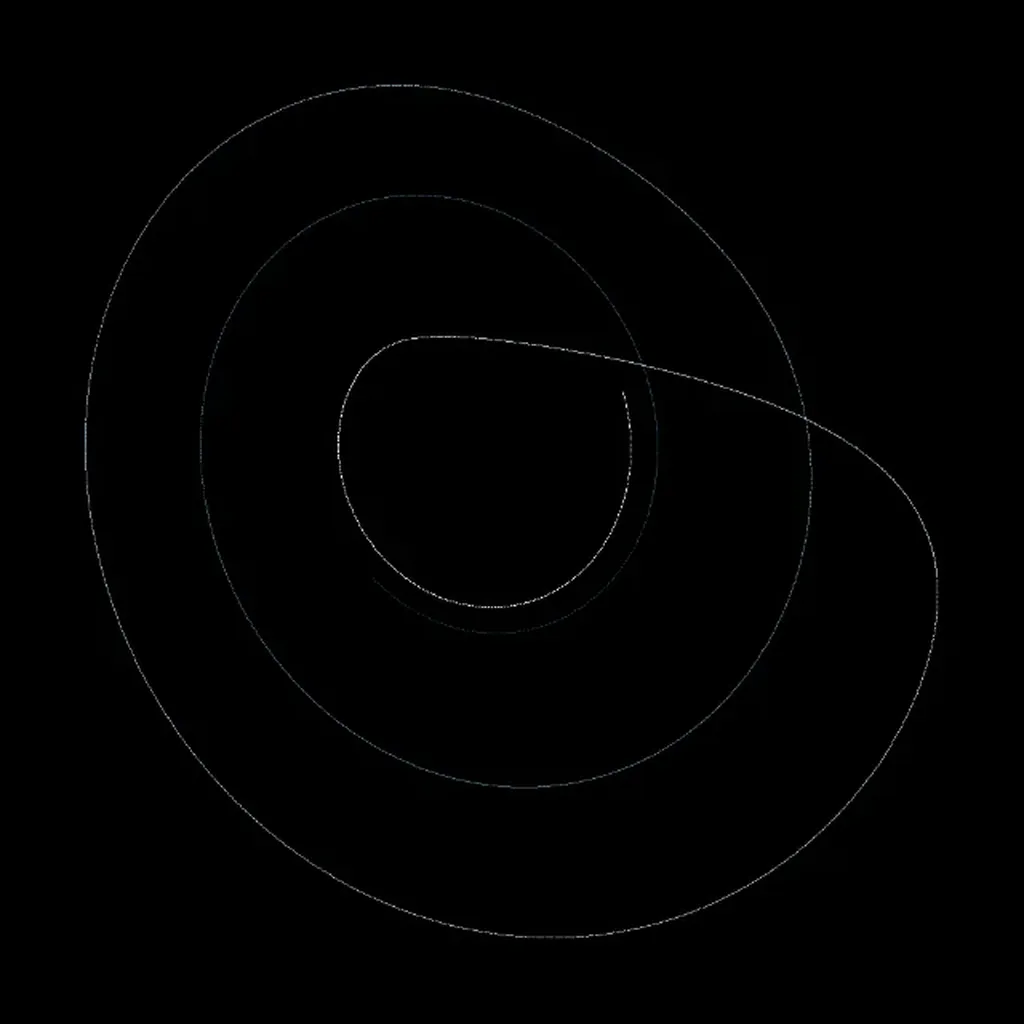
A single trajectory, started at and run forward 60 time units before the first frame, so that it is already on the attractor, projected onto the x-y plane. The line shows the most recent integration steps, 2000 by default, fading from blue (oldest) to white (newest), and the view rescales itself to fit them. Integration uses fourth-order Runge-Kutta by default with four steps of per frame at normal speed. The readout λ₁ (Lyapunov) is a running estimate of the largest Lyapunov exponent, obtained by following a second trajectory that starts away and pulling it back to that distance after every step.
Chaotic (c=5.7): Rössler’s own values, and . Loops of different sizes follow each other in an order that never repeats, and λ₁ settles near .
Period 4 (c=4): below the onset of chaos. The orbit is periodic and closes after four turns of different radius, one stage of the period-doubling cascade that ends in chaos as grows. λ₁ falls to about zero, as it does for any stable periodic orbit.
Band (c=12): chaotic again, with a much larger attractor and λ₁ near .
Governing equation
Near the origin stays small, about , and the first two equations describe an outward spiral that grows like . When approaches the factor turns positive, shoots up, and the term in throws the trajectory back toward the center. The product is the only nonlinearity in the system.
Parameters
a: 0 to 1, default 0.2. Sets how quickly the spiral in the x-y plane unwinds.
b: 0 to 1, default 0.2. The constant drive in , which keeps small and positive while .
c: 0 to 20, default 5.7. The value of beyond which grows, and the main control parameter. With , raising takes the system through a sequence of period doublings into chaos.
Time step dt: 0.001 to 0.05, default 0.01.
Trail length and Trail brightness: how many of the latest points the trail shows (100 to 2000, default 2000) and how bright it is drawn (0 to 1, default 0.85).
Integrator: Runge-Kutta 4 by default. Euler, RK2, leapfrog and Yoshida 4 are available for comparison.