This simulation needs WebAssembly, and it could not start in this browser.
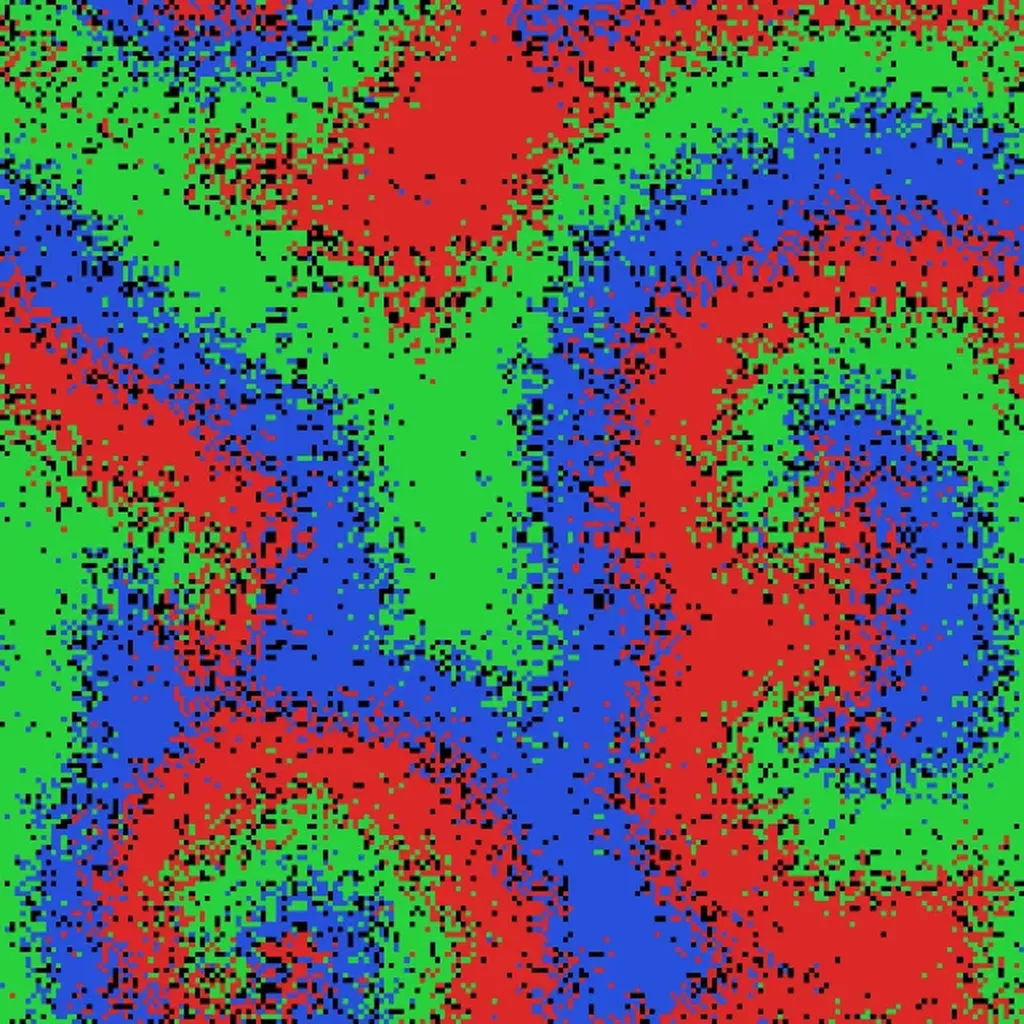
The image is a frame from a real run. Check that JavaScript is on, or try another browser.
In rock, paper, scissors every strategy beats one other and loses to the third, so no single one can win. Ecology has real examples of this cyclic dominance: three color morphs of male side-blotched lizards in California replace each other in turn (Barry Sinervo and Curt Lively, 1996), and three strains of E. coli, one producing a toxin, one sensitive to it and one resistant, coexist on a plate, where each cell meets only its neighbors, but not in a shaken flask (Benjamin Kerr and coworkers, 2002). Tobias Reichenbach, Mauro Mobilia and Erwin Frey showed in 2007 why moving matters (Nature 448, 1046): when individuals compete for space, the three species organize into rotating spiral waves, and as long as they move slowly the spirals protect all three. Above a critical mobility the spirals grow larger than the habitat and two of the species die out.
What you see
A 200 by 200 grid whose edges wrap around. Red cells are rock, blue scissors, green paper, and black cells are empty. Rock kills scissors, scissors kill paper, paper kills rock. Each species chases the one it beats and flees the one that beats it, so the three bands follow each other around the spiral cores. The black specks are the cells a predator has just cleared and nobody has filled yet; about a tenth of the grid is empty at any time.
Rule
One generation is updates on the cells. Each update picks a random cell and one of its four nearest neighbors, and then one of three events with rates 1, 1 and :
Selection (rate 1): if one of the two beats the other, the loser’s cell becomes empty.
Reproduction (rate 1): if one cell is empty and the other is not, the species copies itself into the empty cell.
Exchange (rate ): the two cells swap their contents, empty or not. This is how individuals move.
The mobility measures how far an individual travels in one generation as a fraction of the grid size, so it means the same on any grid. Reichenbach, Mobilia and Frey found the critical value , and below it a spiral wavelength proportional to : mixing smooths the fronts on the scale times the grid size.
Presets
All start from a random grid, each cell empty or one of the three species with equal probability.
Spirals: . Within about 150 generations the noise has organized into a few large spirals, each arm a band of red, green and blue. None of the three species ever drops below 15% of the grid.
Low mobility: . The spirals are small and ragged, a few tens of cells across, and many of them turn at once.
Near the threshold: . The spirals are now about as large as the grid itself, and the same-species correlation reaches about three times as far as at low mobility. The species fractions swing much more widely.
Above the threshold: . Mixing is too fast for spirals to hold. Within about 60 generations two species are gone and the survivor fills the grid: biodiversity is lost.
Parameters
Mobility M: to on a logarithmic slider (default ). It applies immediately: raising it past during a run makes the spirals grow until one species wins.