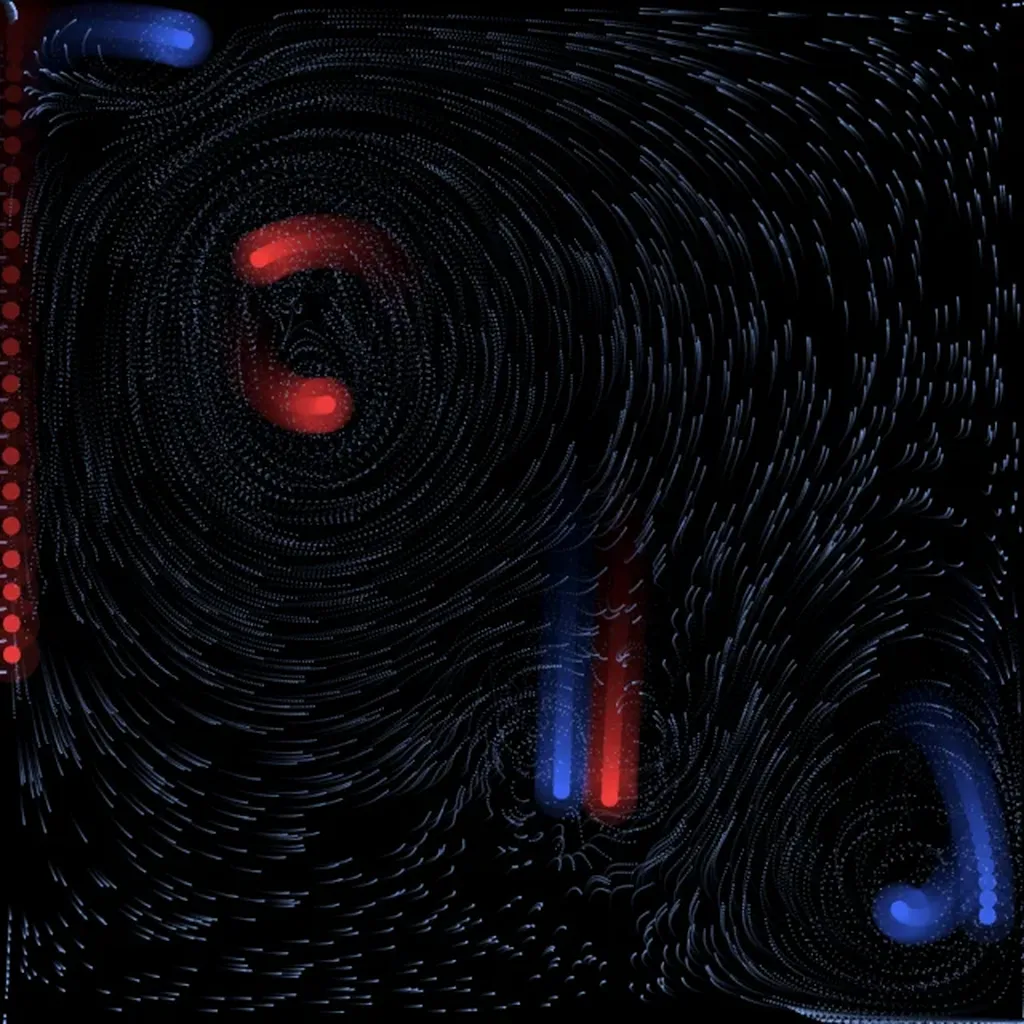
This simulation needs WebAssembly, and it could not start in this browser.
The image is a frame from a real run. Check that JavaScript is on, or try another browser.
In 1858 Hermann von Helmholtz showed that in a fluid without friction vorticity moves with the fluid: a thin vortex stays a vortex forever and is carried along by the flow that all the others induce. In two dimensions this turns a fluid into a small mechanical system. A handful of point vortices, each with a circulation , push each other around by the Biot-Savart law and nothing else, with an energy that never changes. Two vortices move in a fixed pattern, three still in a regular one, four or more generically in chaos.
What you see
A square box with solid walls. Red dots are vortices that turn counterclockwise (), blue ones turn clockwise (). The 2500 small dots are passive tracers carried by the flow; they show its streamlines, the stretching and folding between the vortices, and the fluid swept along with a moving pair.
Time runs at 0.24 box units per second on screen.
Equation
A vortex at induces at the velocity
a rotation around it that falls off as , softened inside a core of radius . Each vortex moves with the sum from all the others; it does not push itself.
The walls work by images. Mirroring each vortex across the walls with opposite sign makes every wall a streamline, and since mirroring across two parallel walls repeats forever, the images fill a lattice with period twice the box. The simulation sums each row of that lattice exactly, using , and keeps three rows; the next ones would add of the speed. A vortex near a wall is pushed along it by its own image. One at a tenth of the box from a wall moves at 0.731, the converged lattice sum, within 2% (measured).
The vortices move by Runge-Kutta 4 with a time step of 0.001, four steps per frame; the tracers by the midpoint rule. The motion conserves the Kirchhoff-Routh energy
measured to better than 1% over 5 time units in the chaotic preset.
Presets
Vortex pair: two opposite vortices 0.3 apart. A pair in open water would travel in a straight line at ; here the walls and the cores slow it to 0.36 (measured), and it carries a pocket of tracers with it. At the wall it splits, the two vortices run along the walls in opposite directions and around the corners, and meet again on the far side: one lap of the box takes about 21 seconds.
Vortex ring: six equal vortices on a circle of radius 0.15. The ring turns rigidly, at 17.4 radians per time unit (one turn in 1.5 seconds), against 17.7 from Kelvin’s with the softened cores; the walls slow it by 1.5%. In linear theory a ring of up to six vortices is stable, seven is marginal, and eight or more break up; try it with the vortices slider.
Chaotic (8 random) and Many vortices (16): random positions with alternating signs, so the total circulation is zero. Pairs form, travel, and trade partners; the tracers mix in thin filaments. Each Reset draws a new layout.
Parameters
Vortices: how many, 2 to 16, for the random layout and the ring. The pair always has two. Changing it starts a new run.
Initial layout: random, pair or ring.
Tracers: show or hide the passive particles.