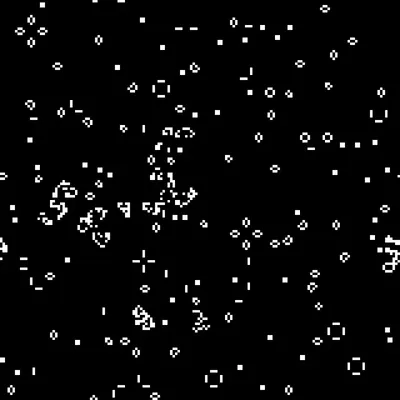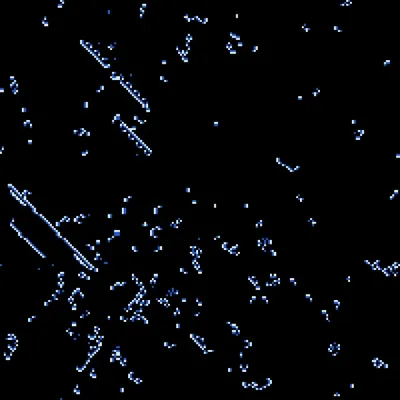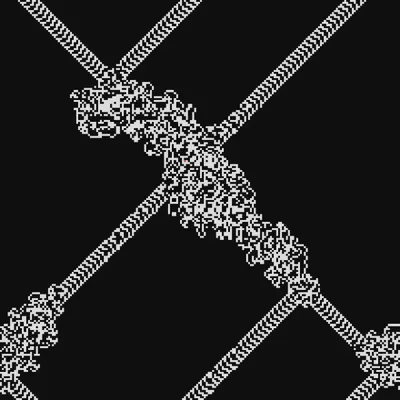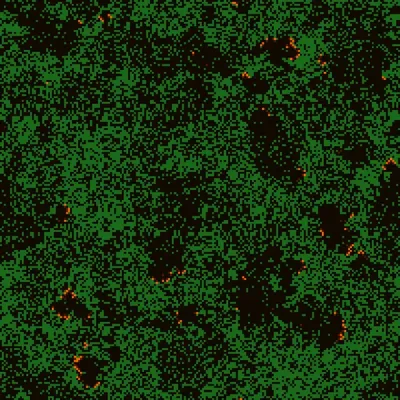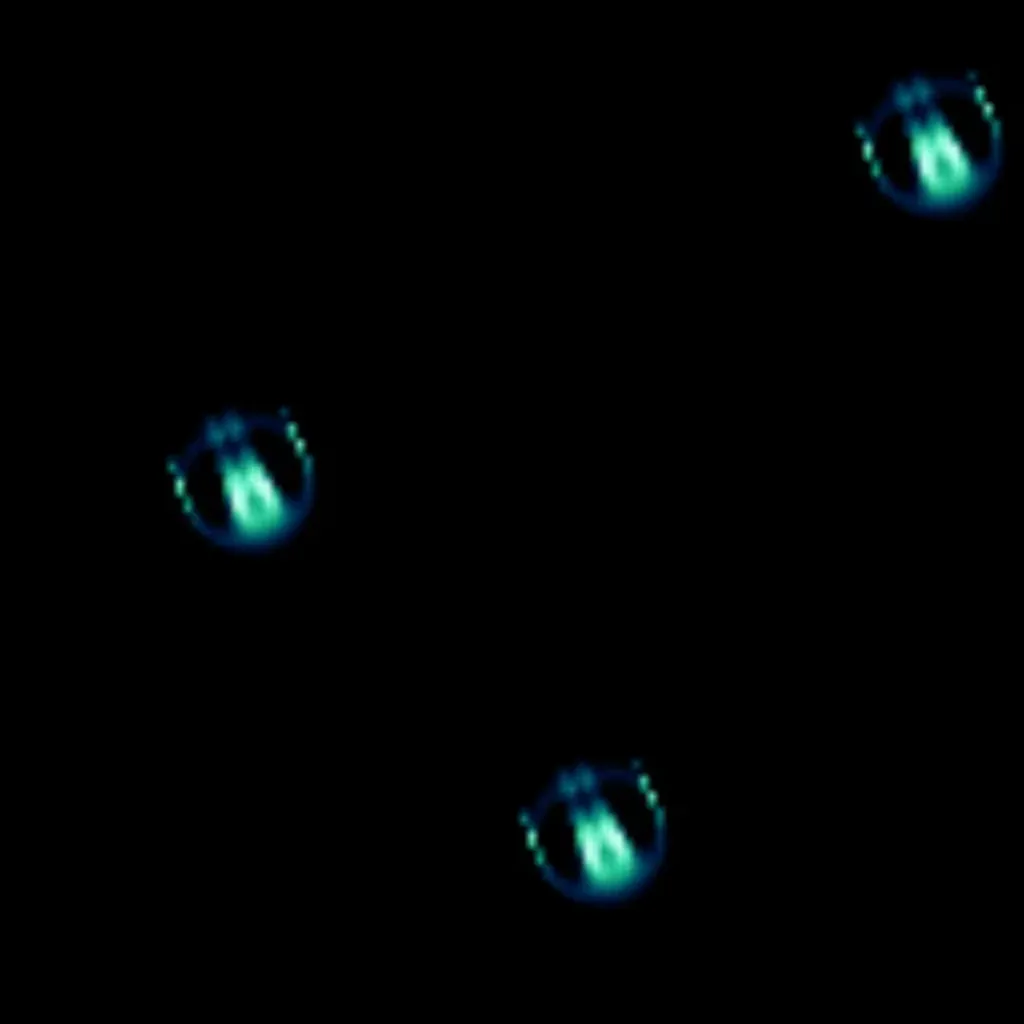
This simulation needs WebAssembly, and it could not start in this browser.
The image is a frame from a real run. Check that JavaScript is on, or try another browser.
Bert Wang-Chak Chan made Conway’s Game of Life continuous in every respect: cells hold real values between 0 and 1 instead of being dead or alive, the neighborhood is a smooth ring instead of the eight adjacent cells, and each step adds only a small fraction of the change. He called the result Lenia (Complex Systems 28, 251, 2019). It turned out to be full of localized, self-organizing patterns that move, rotate and pulse, which Chan collected and named like biological species. Smoothing the rule also makes it close to a partial differential equation, so these creatures keep their shape at any grid resolution once their size is scaled to match.
What you see
A 128 by 128 grid whose edges wrap around. Brightness is the cell value , from black at 0 through teal and green to white at 1. The creatures come from Chan’s published catalog and run at the parameters he found them at; each stays alive only in a narrow range around them.
Rule
Each step first measures how full every cell’s neighborhood is, as a weighted average of the grid over a ring of radius :
The kernel is made of one or more concentric shells. With shells of heights , a cell at distance has weight , where and are the integer and fractional parts of and is a smooth bump that vanishes at the shell edges and peaks at 1 in the middle. Then every cell grows where its neighborhood is just right and decays everywhere else:
The convolution runs through the fast Fourier transform, which computes the sum over all cells of the ring in operations instead of , so a large kernel costs as little as a small one.
Presets
Orbium: three copies of Orbium unicaudatus, the first creature Chan found and the best known, at , , , with a single kernel shell. Each is a compact disc with a tail that glides steadily across the grid; all three share one heading, so they never meet. Their total mass stays within 10% of its start over 1000 frames.
Scutium: Scutium solidus, a shield-shaped creature at , , also with and one shell. Its mass stays within 10% over 1000 frames.
Hydrogeminium: Hydrogeminium natans, a much larger and more intricate creature that needs a kernel of three shells with heights , and at , with and . It too keeps its mass within 10% over 1000 frames.
The patterns are taken from Chan’s catalog in his Lenia repository (MIT license).
Parameters
Growth center μ: 0.05 to 0.4. Growth width σ: 0.005 to 0.1. Kernel radius R: 6 to 30 cells. Time step dt: 0.02 to 0.5, the reciprocal of Chan’s . All four apply immediately. The creatures exist only near their own values, so even a small change in or makes them grow into a spreading blob or fade away, and a different changes the scale they would need to have. Reset brings the creature back.
Color map: the default teal and green scale or one of the standard maps.