This simulation needs WebAssembly, and it could not start in this browser.
The image is a frame from a real run. Check that JavaScript is on, or try another browser.
Fireflies along a riverbank flash in unison, pacemaker cells in the heart fire together, and the audience of a concert sometimes falls into one rhythm of applause. Each of these is a population of oscillators with slightly different natural frequencies that pull on each other. Arthur Winfree saw in 1967 that such a population can synchronize suddenly once the coupling passes a threshold, and Yoshiki Kuramoto turned this into a model that can be solved exactly (1975). Steven Strogatz tells the story in Sync (2003) and reviews the mathematics in Physica D 143, 1 (2000).
What you see
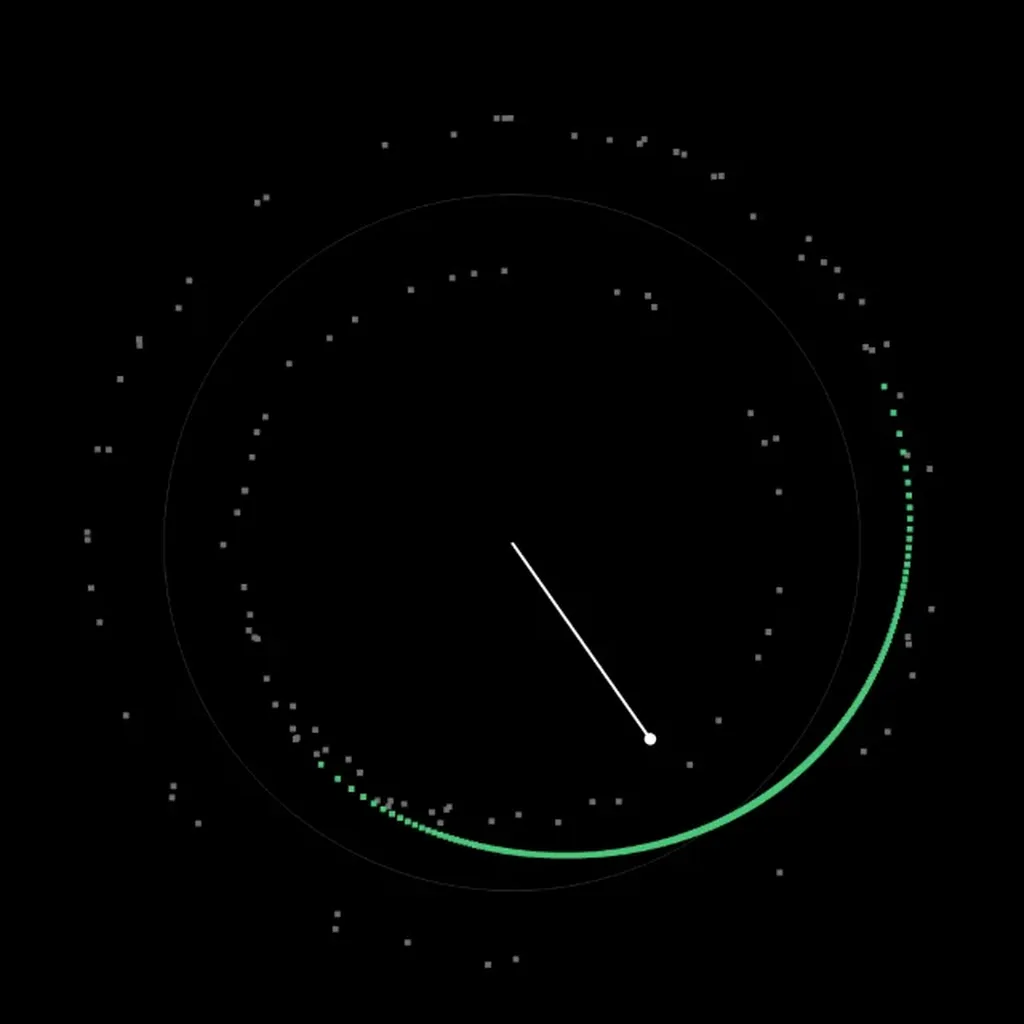
oscillators on a circle, each at its current phase . The distance from the center grows with the oscillator’s natural frequency , slow ones inside, fast ones outside, so the circle is really a band. Green dots are locked: the mean field holds them at a fixed phase. Gray dots drift: they are too fast or too slow to be held and keep lapping the others. The white arrow is the order parameter , the average of all : its length is 0 when the phases are spread evenly and 1 when they all agree. The readout compares with Kuramoto’s exact value for infinitely many oscillators.
The locked oscillators form a tilted arc: an oscillator with natural frequency sits at the angle from the mean phase, ahead of it if it is fast and behind if it is slow, so the arc ends where .
Equations
The second form is Kuramoto’s key step: every oscillator feels only the mean field, with a pull proportional to . A stronger mean field locks more oscillators, which makes the mean field stronger still. For natural frequencies drawn from a Lorentzian of half-width this feedback has a closed solution: below the critical coupling and
above it. The transition is continuous, like the magnetization of a ferromagnet at its Curie point, with growing as the square root of the distance from .
The natural frequencies are the quantiles of the Lorentzian, , so the distribution is the same on every run and exactly symmetric, and the locked arc stands still instead of turning with a random mean frequency. The phases start uniformly at random. The equations are integrated with fourth-order Runge-Kutta at a step of 0.02, two steps per frame.
Presets
Locked: , twice the critical coupling. Within about 10 time units (4 seconds) rises to the exact value ; with 2000 oscillators the measured average stays within 0.03 of it, as it does for and .
Just above the threshold: , where the exact value is . About half of the oscillators lock, and near the threshold everything is slow: the arc takes much longer to form and wanders more.
Incoherent: , half the critical coupling. No arc forms and stays at the level of chance, about , below 0.08 with 2000 oscillators.
Strong coupling: , . Most oscillators lock into a tight arc; only the far tails of the Lorentzian still drift.
Parameters
Coupling K: 0 to 10 (default 4). Applies immediately, so moving it across during a run shows the arc forming or dissolving.
Frequency spread γ: the half-width of the Lorentzian, 0.1 to 5 (default 1). It sets . Changing it restarts the run.
Oscillators N: 10 to 2000 (default 500). With few oscillators fluctuates strongly and the threshold is blurred; the exact result holds for . Changing it restarts the run.
Time step dt: 0.002 to 0.1 (default 0.02).