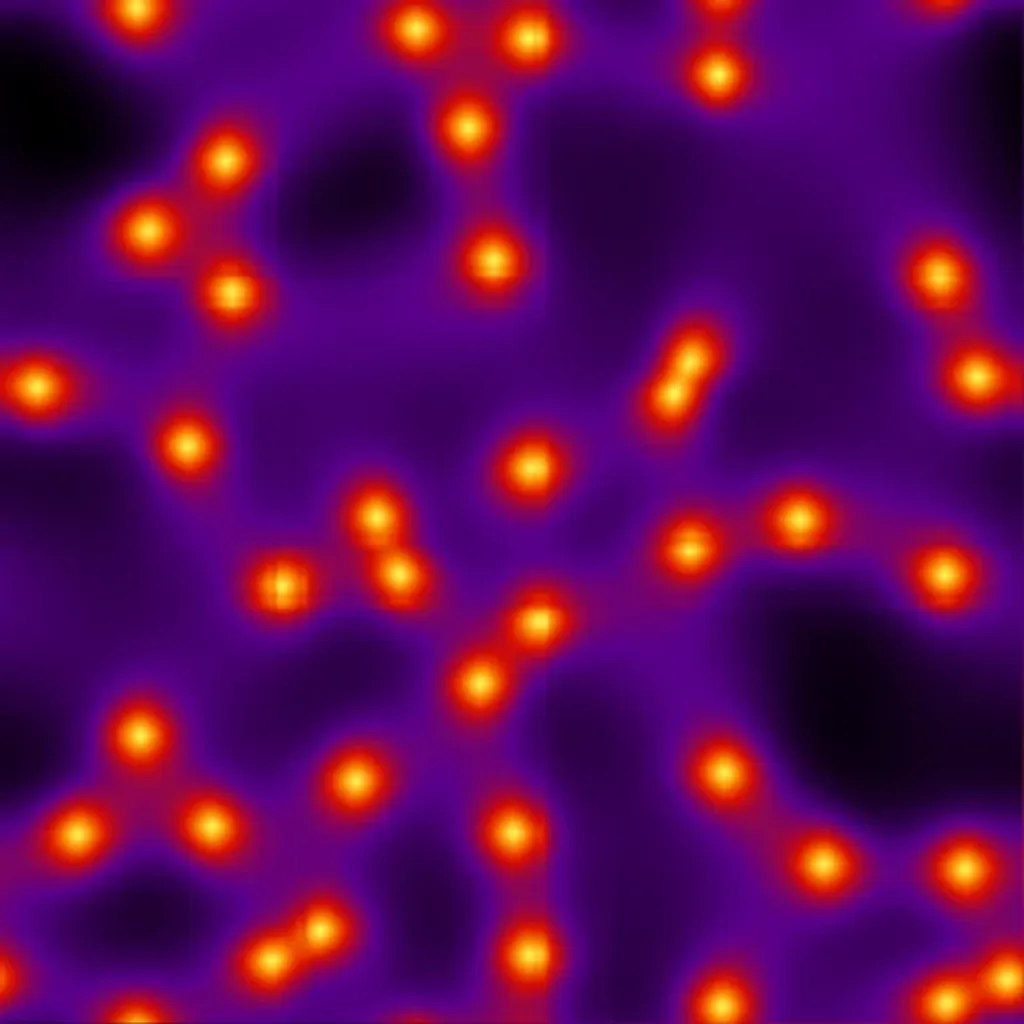
This simulation needs WebAssembly, and it could not start in this browser.
The image is a frame from a real run. Check that JavaScript is on, or try another browser.
When food runs out, amoebae of the slime mold Dictyostelium discoideum stop living alone. They release the signaling molecule cyclic AMP, move toward higher concentrations of it, and gather into dense clusters that go on to form a multicellular fruiting body. Evelyn Fox Keller and Lee Segel wrote down the continuum model for this in 1970 and showed that aggregation starts as an instability: cells that drift up the gradient of a chemical they produce themselves reinforce that gradient, and once this feedback beats random motion, an even spread of cells cannot last. The same equations, often simply called the chemotaxis model, are used for bacteria, immune cells and tumor invasion, and their tendency to concentrate mass into a point has made them a classic problem of mathematical analysis.
What you see
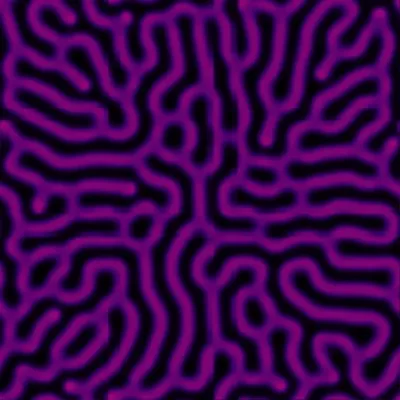
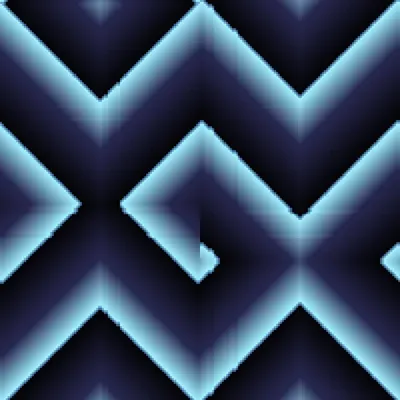
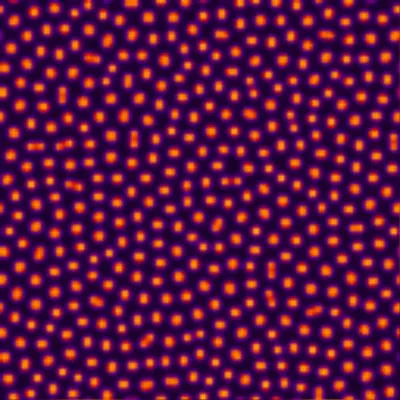
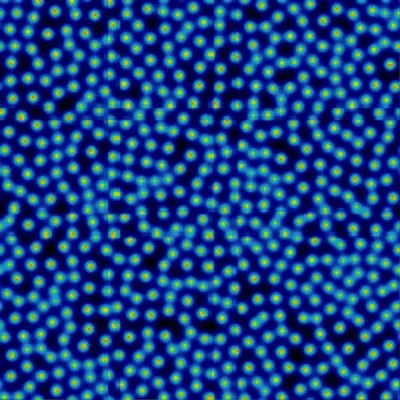
The color shows the cell density on a logarithmic scale, stretched every frame from the lowest value (dark, but no lower than of the highest) to the highest (bright), so the thin population between the aggregates stays visible next to their peaks. The grid has 200 by 200 cells and covers a square of side 10 whose edges wrap around. Every run starts from and , the uniform steady state, with random noise of on both fields. With the default coefficients each frame advances 8 time steps of at most , so about 0.005 time units; the step shrinks when density gradients get steep.
Governing equation
Cells (density ) diffuse, drift up the gradient of the attractant with speed , and grow logistically toward . The attractant diffuses, is secreted by the cells at rate and decays at rate . Linearizing around the uniform state gives a band of growing wavelengths as soon as
which is about 0.43 for the default coefficients. Without growth () the total number of cells is conserved, and in two dimensions an aggregate that holds more than a critical mass collapses into a point in finite time. For the closely related model in which adjusts instantly, that mass is , here about 0.08, far below the 100 cells that the grid holds. For the growth term is known to keep solutions bounded in two dimensions.
The equations are solved on the grid with explicit steps. The chemotactic flux is taken from the cell upstream of each cell face, which conserves the cells exactly and keeps the density from turning negative, and the time step follows both the diffusion limit and the drift speed.
Presets
All presets use , and .
Aggregation (χ = 8): , , also the default. The noise turns into a fine network within a second and breaks up into about 200 bright spots at 1.7 seconds. Dense spots lose cells to the growth term, which pushes back toward 1, and neighbors merge: 125 spots remain after 5 seconds, 55 after 10 and about 20 after 30. From then on old aggregates fade and new ones appear between them, and the number stays near 20 for at least two and a half minutes, with peak densities of up to about 25 against a mean density of 0.04 to 0.08.
Below threshold (χ = 0.3): the same coefficients with under . The noise smooths out: after 25 seconds the density varies by less than 0.002 around 1. Just above the threshold, at , the noise neither dies nor visibly grows within that time.
Strong chemotaxis (χ = 15): , . Faster aggregation into a finer pattern, about 400 spots after one second, which then coarsen the same way.
Without growth (μ = 0): the original Keller-Segel model. The total stays constant to five digits. The aggregates do not dissolve; each one collapses into a single grid cell, the grid’s version of the blow-up, with densities near 500 after 10 seconds. As the gradients steepen, the time step falls tenfold and the collapse slows down on screen.
Parameters
Chemotactic sensitivity χ: how strongly cells follow the attractant gradient. Above the uniform state breaks up.
Cell diffusion and Attractant diffusion: the random motility of the cells, , and the diffusion coefficient of the attractant, . Both raise the threshold when growth is on.
Growth rate μ: the logistic growth rate. It sets how fast the uniform density is restored and how quickly crowded aggregates lose cells.
Secretion rate α and Decay rate β: production and breakdown of the attractant. Their ratio is the attractant level of the uniform state.
All controls act immediately on the running simulation.