This simulation needs WebAssembly, and it could not start in this browser.
The image is a frame from a real run. Check that JavaScript is on, or try another browser.
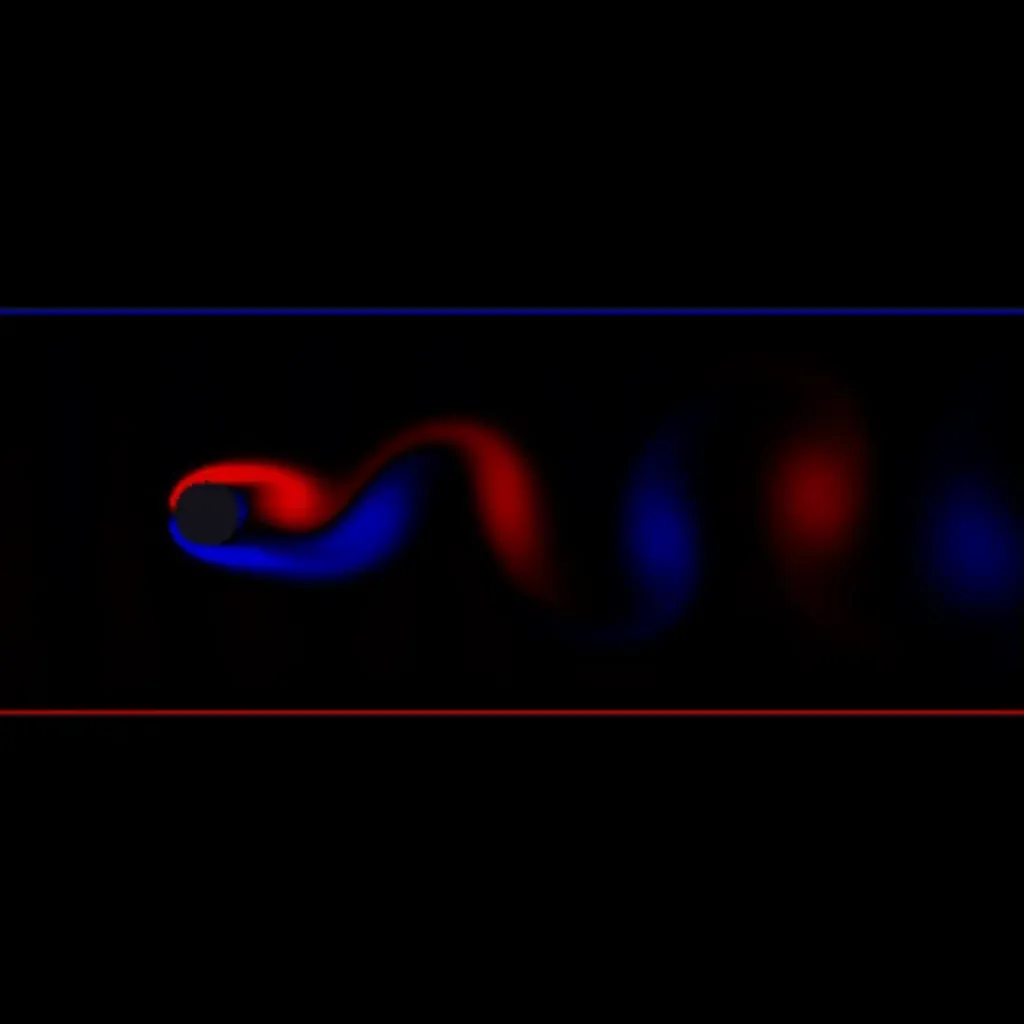
Flow past a cylinder stays steady and symmetric only while it is slow. Above a Reynolds number of about 47 the two eddies behind the cylinder start to swing, and the wake sheds vortices from the top and the bottom in turn, which then drift downstream in two staggered rows. Theodore von Kármán explained in 1911 why that staggered arrangement is the stable one. The same street forms behind chimneys, islands in the wind and telephone wires, and its regular push is why wires hum and tall structures need helical strakes.
What you see
Vorticity in a channel of 320 by 128 cells: red and blue mark spin of opposite sense. Fluid enters from the left at speed (lattice units) and leaves on the right. The cylinder, 20 cells across, sits a fifth of the way along. The top and bottom are slippery walls that only keep the fluid in, so no boundary layers grow on them. The two thin sheets of vorticity peeling off the cylinder roll up into the vortices of the street; about three of its wavelengths fit behind it.
The run starts with a small sideways kick behind the cylinder, so the shedding is in full swing after about 5 seconds; from an exactly symmetric start it takes much longer.
Equation
The lattice Boltzmann method evolves populations moving along the nine directions of a square lattice, which relax toward a local equilibrium with relaxation time ; their moments obey the incompressible Navier-Stokes equations with viscosity . The cylinder reflects populations back the way they came (halfway bounce-back, no slip); the side walls reflect them like a mirror. A frame is 16 lattice steps.
The Reynolds number sets the viscosity. The shedding frequency is measured by the Strouhal number . Measured from the cross flow three diameters behind the cylinder: at Re = 60, 0.193 at Re = 120 (one period every 1.35 seconds on screen) and 0.211 at Re = 200. Williamson’s fit for a cylinder in open flow gives 0.136 and 0.173 at the first two; here the cylinder blocks 16% of the channel, so the flow squeezes past it about a fifth faster than it enters, and it sheds faster in proportion. At Re = 45 and below the kick dies away and the wake turns steady; from Re = 50 on the shedding sustains itself.
Presets
Steady wake: Re = 30. Two still eddies sit behind the cylinder, mirror images of each other.
Near onset: Re = 50. A gentle, slow swinging of the wake; the vortices barely roll up.
Classic street: Re = 120. Strong, regular shedding and the textbook double row of vortices.
Faster shedding: Re = 200. In two dimensions the street stays periodic; a real cylinder turns three-dimensional near Re = 190, which a flat simulation cannot show.
Parameters
Reynolds number Re: 20 to 220. Applies live.
Display: vorticity, speed or pressure; streamlines can be drawn on top.