This simulation needs WebAssembly, and it could not start in this browser.
The image is a frame from a real run. Check that JavaScript is on, or try another browser.
In 1976 the French astronomer Michel Hénon looked for the simplest system that still has a strange attractor. He took the Lorenz equations as his inspiration, replaced the flow with a map of the plane onto itself, and kept only what was needed: a fold, a contraction and a flip. The result is two lines of algebra whose attractor has the layered, self-similar structure of a fractal.
What you see
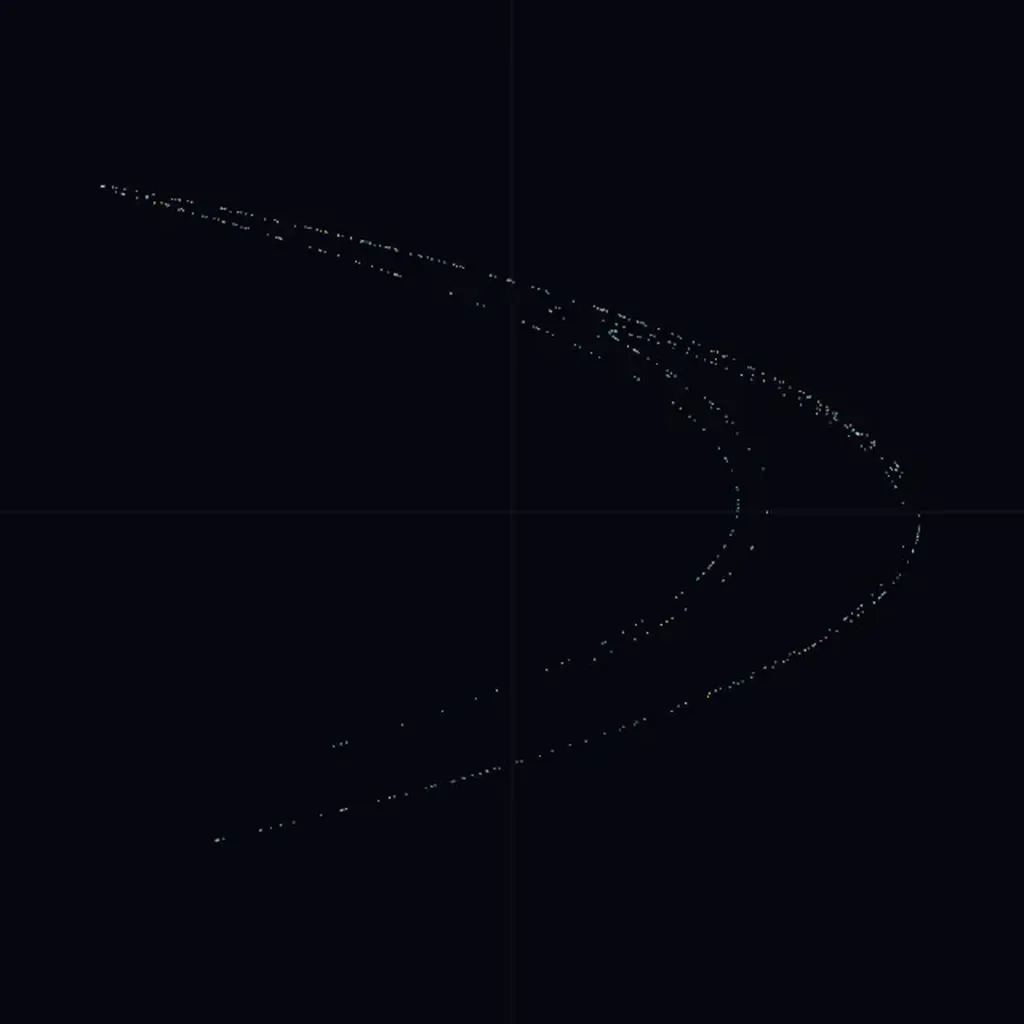
Five hundred points start at random positions in the square . Each one is an independent orbit, and every frame applies the map to all of them several times. Only the current positions are drawn, as small dots in eight colors that simply mark groups of orbits. Within a few iterations the points that stay bounded land on the attractor, and because the motion on it is chaotic they spread over all of it: the dots sketch a curved band of fine parallel strands, and the picture shimmers as they jump along it. An orbit that wanders beyond or is restarted near the origin. The current values of and are printed in the corner.
Strange attractor (a=1.4): Hénon’s parameters, and . The attractor is locally the product of a smooth curve and a Cantor set. Its Lyapunov exponents are about and per iteration, which gives a Kaplan-Yorke dimension of .
Period-7 window (a=1.232): , , inside the periodic window that interrupts the chaos between about and . Every orbit that stays bounded is drawn onto the same stable cycle of seven points, so within a few frames the dots gather on seven spots and jump between them.
Attractor crisis (a=1.42): , , just below a boundary crisis. Between and the attractor grows until it touches the edge of its basin of attraction and is destroyed; above that value orbits wander chaotically for a while and then escape. At 1.42 the attractor still exists and is slightly larger than at 1.4.
The rules
The Jacobian determinant is everywhere, so each iteration multiplies areas by and, for , reverses orientation. For areas shrink, and bounded orbits are drawn onto an attractor of zero area. For the map reduces to the one-dimensional quadratic map , which is equivalent to the logistic map. For it preserves area.
Parameters
a (fold parameter): the strength of the fold, 0.5 to 2 (default 1.4). At the slider starts on a stable cycle of period 2; as grows, the period doubles again and again until chaos sets in near , interrupted later by periodic windows such as the period-7 window near .
b (contraction): the area factor, to 1 (default 0.3).
Number of orbits: the number of independent orbits, 100 to 2000 (default 500).
Steps per frame: the number of iterations per frame, 1 to 50 (default 10).