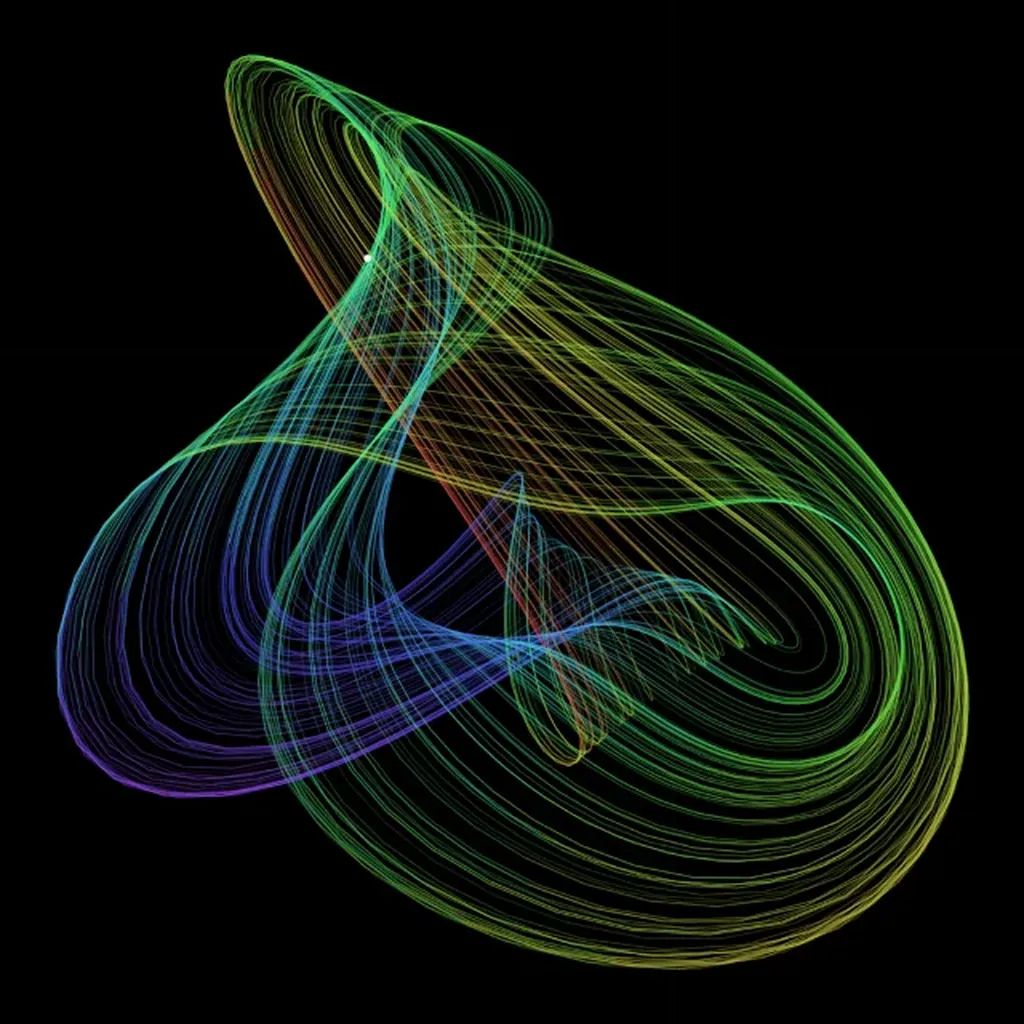
This simulation needs WebAssembly, and it could not start in this browser.
The image is a frame from a real run. Check that JavaScript is on, or try another browser.
The three Halvorsen equations are one equation written three times: each variable is damped by times itself, pushed by the other two, and driven by the square of the next one in the cycle . Swapping the variables around that cycle leaves the system unchanged, which is a rotation by about the diagonal . Rotating any orbit by that angle gives another orbit, and the attractor, when there is one, has three equivalent lobes.
What you see
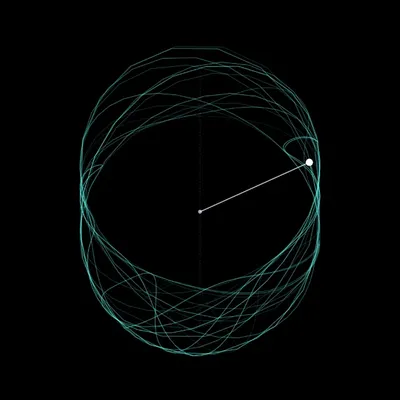
The trajectory starts at and is projected onto the x-y plane. Its color shows , from red (low) to violet (high), scaled to the range the trail covers, the white dot is the current position, and the current and are printed in the corner. The view follows the trajectory with the same scale on both axes: it widens at once when the orbit reaches its edge and narrows slowly when the orbit occupies less. Because the symmetry axis is the diagonal and not the axis, the threefold symmetry appears distorted in this view. Integration uses fourth-order Runge-Kutta by default, each step of split into four substeps, with eight steps per frame.
Canonical (α=1.4): chaotic. The orbit moves from lobe to lobe in an order that never repeats.
Loose chaos (α=1.27): weaker damping, close to the lower end of the bounded range: below about the orbit from this starting point escapes to infinity and the simulation stops. The motion is more strongly chaotic than at 1.4, with a largest Lyapunov exponent near 0.8 instead of about 0.65.
Period 3 (α=1.7): from about on, the stronger damping ends the chaos. Here the orbit settles onto a closed loop through all three lobes that crosses the plane upward at three different points per period.
Periodic orbit (α=2.2): a simpler periodic orbit, slightly smaller, with two upward crossings of per period.
Governing equation
The divergence of the flow is everywhere, so any volume of starting points shrinks by the factor per unit time, wherever it is. The quadratic terms keep the motion from simply decaying. They are never positive, so they always push toward negative values, which is why the attractor lies mostly at negative coordinates, reaching about .
Parameters
α (dissipation): 0.5 to 2.5, default 1.4. The only parameter. Too small and orbits escape; in a middle range the motion is chaotic; larger values give periodic orbits.
Time step dt: 0.005 to 0.05, default 0.02.