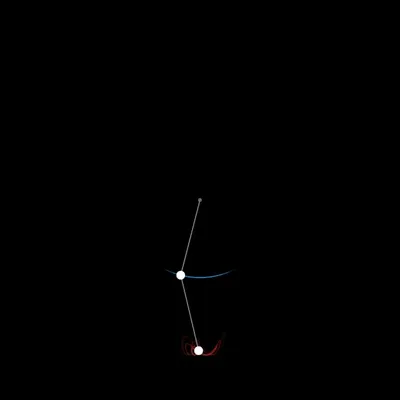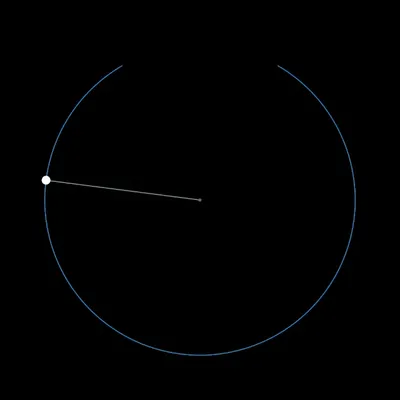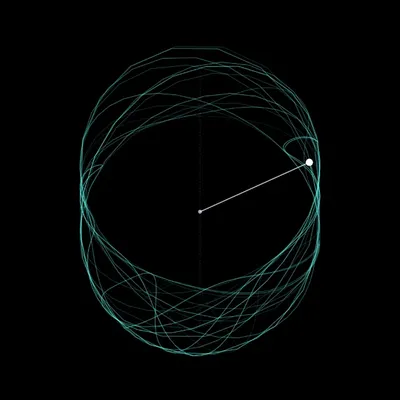
This simulation needs WebAssembly, and it could not start in this browser.
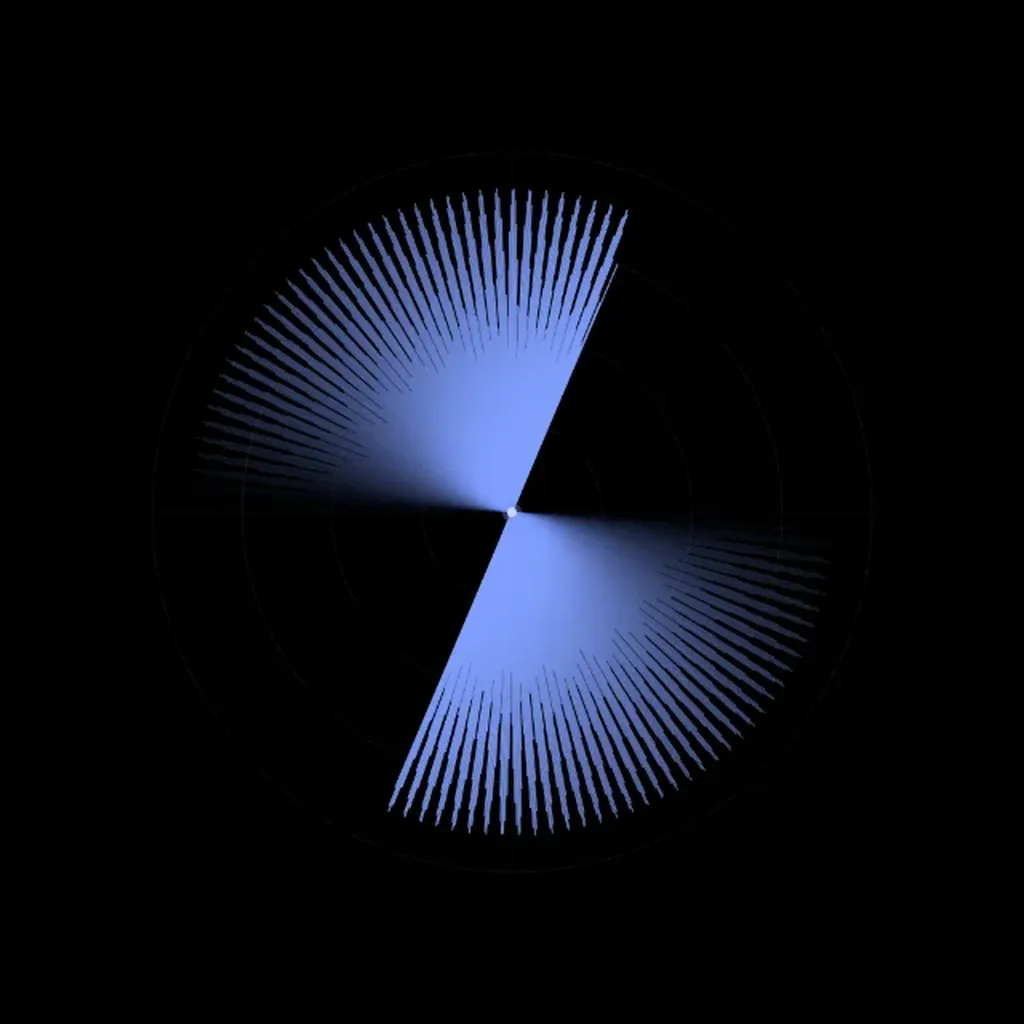
The image is a frame from a real run. Check that JavaScript is on, or try another browser.
In 1851 Léon Foucault hung a 28 kg bob on a 67 m wire under the dome of the Panthéon in Paris. Over the following hours the plane of its swing turned clockwise, as seen from above, about once every 32 hours. Nothing pushes the pendulum sideways. The plane stays put while Earth turns underneath it, and the pendulum became the first demonstration of Earth’s rotation that needed no observation of the sky.
What you see
The floor seen from above: guide rings 0.5 m apart out to 2 m, the suspension point in the center, and the bob with a fading trail. Time runs 1800 times faster than in reality, so each frame advances 30 s, more than three full swings of the default 20 m pendulum (period 9.0 s). The bob is therefore seen stroboscopically. It jumps back and forth along its swing line instead of gliding, and the trail of these samples shows the line slowly turning. At normal speed one hour passes in 2 s.
Paris (48.8°N, 31.8 h): a 20 m pendulum released 1.8 m from the center at the latitude of the Panthéon. The plane turns once in 31.8 h, about a minute on screen.
North pole (90°, 24 h): the full rotation rate of Earth acts on the swing plane, which turns once per sidereal day of 23.9 h.
Tropics (23.5°N, ~60 h): a full turn takes 60 h, about half the rate at Paris.
Long pendulum (100 m): the Paris latitude with a 100 m pendulum, which swings with a period of 20 s. The precession rate does not depend on the length, so the plane still turns once in 31.8 h.
Governing equation
For small swings, with pointing east and north, the bob moves in Earth’s rotating frame as
where and is the vertical component of Earth’s angular velocity rad/s at latitude . The horizontal component of the rotation and the centrifugal term are neglected. With the pair becomes , and the substitution turns it into : an ordinary pendulum swing in a frame that turns clockwise at the rate . One full turn takes
The bob starts at rest, displaced east by the chosen amplitude. The equations are integrated with fourth-order Runge-Kutta by default, in substeps short enough that : 421 per frame for the 20 m pendulum. Runge-Kutta slowly drains energy from an oscillation, and at this step size the 20 m swing at Paris loses less than 0.1 % of its amplitude over a full turn of the plane.
Parameters
Latitude: 1° to 90° north, default 48.8°. It sets the precession period through .
Length (m): 2 to 100 m, default 20. It sets the swing period , but not the precession.
Amplitude (m): 0.2 to 2 m, default 1.8, the distance from the center at which the bob is released.