This simulation needs WebAssembly, and it could not start in this browser.
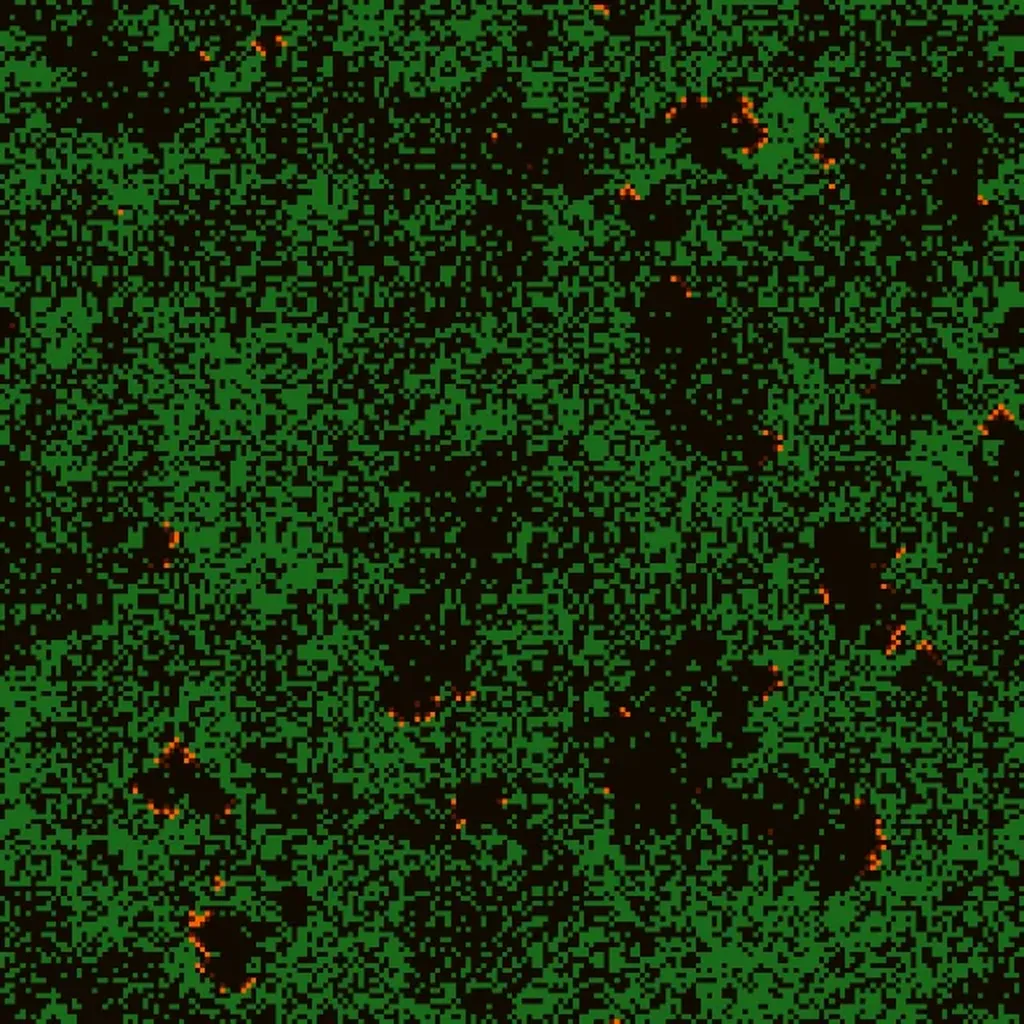
The image is a frame from a real run. Check that JavaScript is on, or try another browser.
Per Bak, Kan Chen and Chao Tang proposed a forest-fire model in 1990. Barbara Drossel and Franz Schwabl added lightning in 1992, and their version became a standard example of self-organised criticality: a slowly driven system that, without any tuning, keeps returning to a state where disturbances of every size occur. Trees grow one by one, a single lightning strike can burn down a whole connected patch of forest, and the forest density settles where growth and burning balance.
What you see
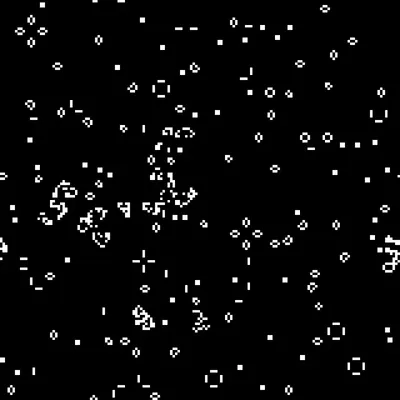
A 200 by 200 grid whose edges wrap around, so the grid is a torus. Green cells are trees, orange cells are burning, dark red cells are embers that burnt out one step ago, and near-black cells are empty ground. The panel shows the fraction of cells that hold a tree and the entropy of the grid.
Every run starts with 60% of the cells planted at random. That forest is above the percolation threshold of the square lattice (about 59%), so the first lightning strikes burn most of it within 20 to 60 generations and leave 10 to 15% of the cells with a tree. The forest then regrows, overshoots, burns again, and after at most about 600 generations (10 seconds at 60 frames per second, one generation per frame) the tree density fluctuates around a steady value.
Rule
Each generation updates all cells at once:
- an empty cell grows a tree with probability ,
- a tree catches fire if at least one of its four nearest neighbors (up, down, left, right) is burning, and otherwise is struck by lightning with probability ,
- a burning tree becomes an ember, and an ember becomes empty ground.
The ember step is the only difference from the original model, where a burning tree turns into empty ground at once. Fire fronts spread one cell per generation, so a single fire on open forest grows as a diamond.
In the steady state, trees grow as fast as they burn. With tree density , about trees grow per generation on cells, and lightning strikes trees, so each strike burns on average
trees. The ratio therefore sets the typical fire size. The critical state is the limit , : on a large enough lattice the tree density approaches about 0.41, and the number of fires of size falls off as a power law, , with a little above 1 in two dimensions. Large simulations by Peter Grassberger (2002) found that this scaling is not clean, so whether the model is truly critical is still debated. On this 200 by 200 grid, fires are cut off long before that limit: there are always several fires burning at once.
Presets
Rare lightning (p/f = 50): , , also the default. About 1.5 lightning strikes per generation, each burning about 85 trees on average. The tree density averages 0.37 and swings between 0.31 and 0.43 as large fires sweep through mature forest and leave wide empty scars that slowly fill in again.
Moderate lightning (p/f = 10): , . Slower growth and more strikes: about 2.6 strikes per generation, about 21 trees per strike, and a density of 0.32 that stays between 0.29 and 0.35.
Frequent lightning (p/f = 2): , . About 20 strikes per generation, about 6 trees per strike. Most trees burn alone or in small groups before the forest can connect, and the density stays at 0.25 with hardly any fluctuation.
Raising further brings the density closer to the critical value: with and () it averages 0.42 and swings between 0.33 and 0.52.
Parameters
Growth probability p: the chance per generation that an empty cell grows a tree, 0.0001 to 0.02, on a logarithmic slider. It sets how fast burnt areas fill in.
Lightning probability f: the chance per generation that a tree is struck and catches fire, 0.00001 to 0.002, on a logarithmic slider. Together with it sets the ratio and with it the size of the fires.
Both apply immediately, without restarting the forest.