This simulation needs WebAssembly, and it could not start in this browser.
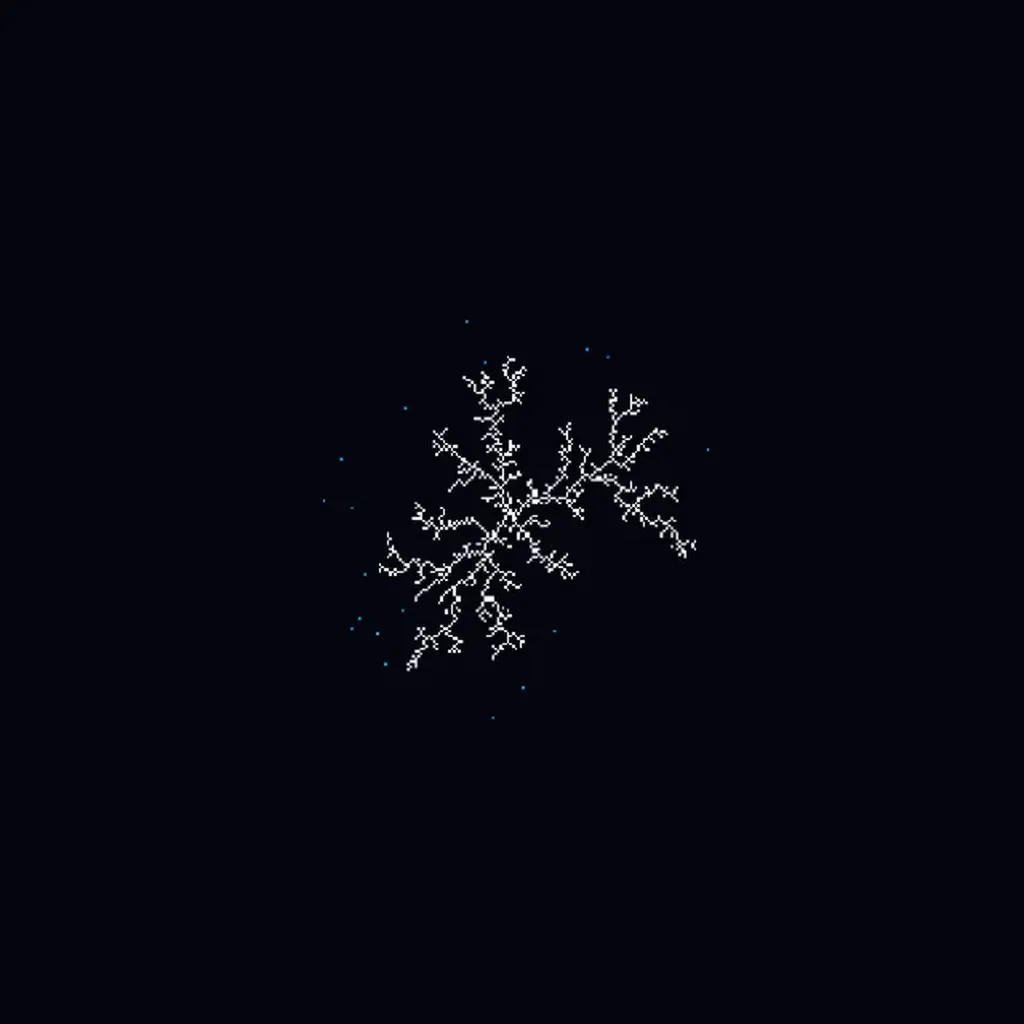
The image is a frame from a real run. Check that JavaScript is on, or try another browser.
Thomas Witten and Leonard Sander described diffusion-limited aggregation in 1981: particles wander at random until they touch a growing cluster, and stick where they touch. Nothing in the rule is fractal, yet the cluster grows into a branching tree with branches on every scale. The reason is screening: a wandering particle almost always meets an outer tip before it can reach the fjords between branches, so the tips grow and the fjords stay empty. The same mechanism shapes metal deposited from a solution, mineral dendrites on rock, viscous fingers and some bacterial colonies.
What you see
A 400 by 400 grid with a single seed cell in the middle. White cells belong to the cluster, cyan dots are walkers still on their way. Each walker starts on a circle a little outside the cluster, steps to a random one of its four neighbor cells 64 times per frame, and sticks as soon as one of its eight surrounding cells is part of the cluster; then a new walker starts.
Model
The walkers sample the solution of the diffusion equation around the cluster: the cluster grows fastest where the gradient of the walker density is steepest, at the tips. A walker that wanders outside its starting circle would come back to it some time later, so instead of following it the simulation puts it back on the circle at once, at a point drawn from the probability that a random walk from its position first returns there (the circle’s Poisson kernel). Without that step, launching it again uniformly would feed the outer tips too much and thin the cluster.
The mass of a DLA cluster grows with its radius of gyration as
in two dimensions, between a line () and a filled disk (). Measured here from 300 cells to the edge of the grid, the default cluster gives .
Presets
Standard DLA: 20 walkers at a time, also the default. Close to the textbook limit of one walker at a time: after a minute the cluster holds about 2,400 cells and reaches 110 cells from the seed, and after four minutes about 5,200 cells reach nearly the edge of the grid.
Crowded walkers: 300 walkers at a time. The cluster grows twenty times faster and reaches the edge within 20 seconds, but it is no longer pure DLA: the walkers crowd the rim and stick before they have wandered far, and the measured dimension drops to 1.56.
Parameters
Walkers: 1 to 300 random walkers at once. Applies immediately; Reset starts a new cluster.