This simulation needs WebAssembly, and it could not start in this browser.
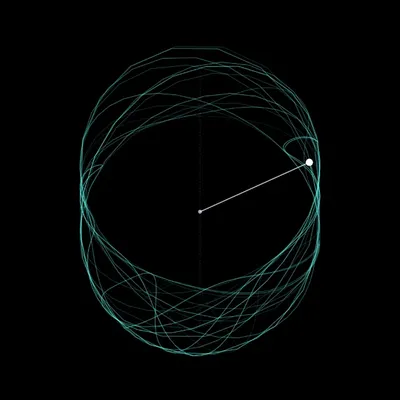
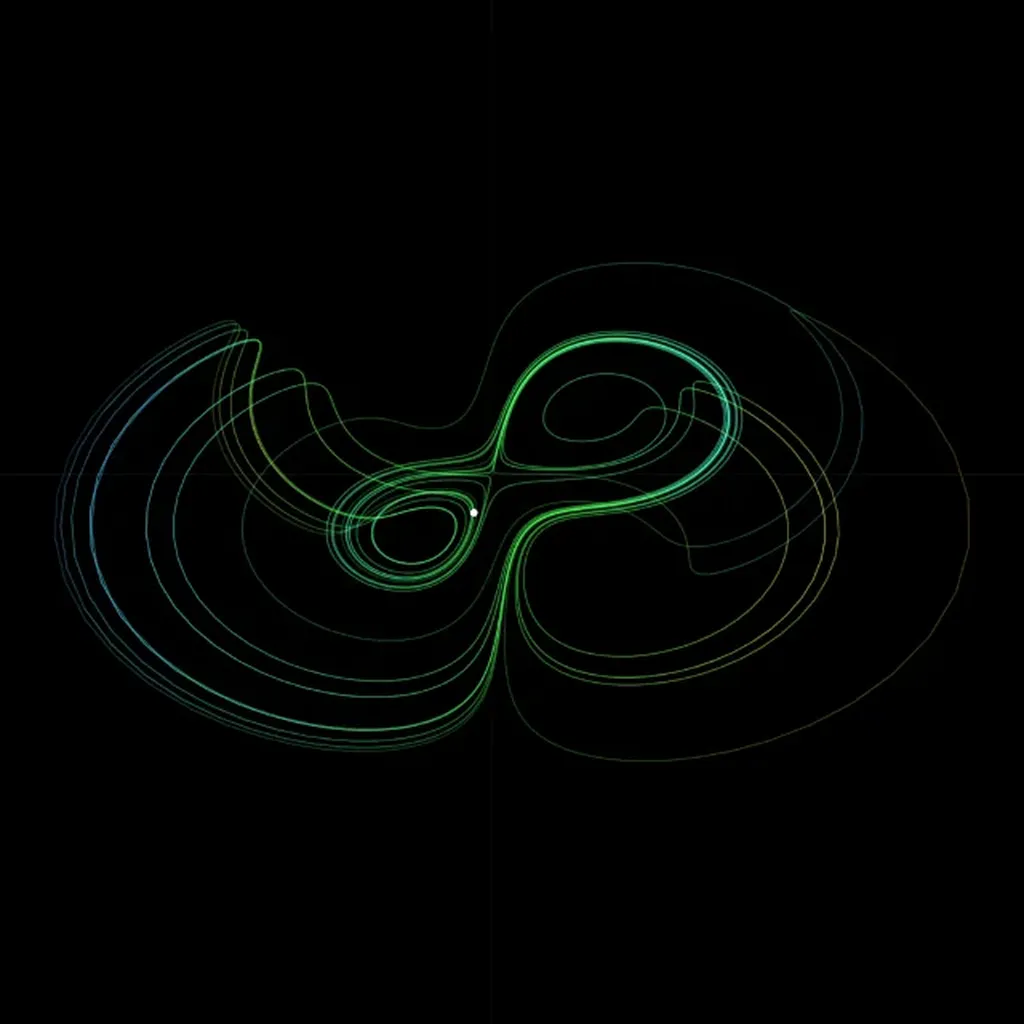
The image is a frame from a real run. Check that JavaScript is on, or try another browser.
Dadras and Momeni presented this system in 2009 as a three-dimensional flow that, depending on its five parameters, produces attractors with two, three or four scrolls. It has three quadratic terms, , and , and one linear term, in the second equation, that breaks what would otherwise be a symmetry between positive and negative and . Five parameters make a large space to explore; the presets cut through it along and .
What you see
The trajectory starts at and is projected onto the x-y plane. Its color shows , scaled to the range the trail covers, the white dot is the current position, and the current is printed in the corner. The view follows the trajectory with the same scale on both axes: it widens at once when the orbit reaches its edge and narrows slowly when the orbit occupies less. Integration uses fourth-order Runge-Kutta by default, each step of split into four substeps, with eight steps per frame.
Canonical chaos: , the values most often used for this system. The motion is chaotic, with a largest Lyapunov exponent of roughly . The orbit spans about to in .
Period-2 (a=2.0): with weaker damping of the orbit is periodic and closes after two loops of different shape.
Wide wings (d=0.5): a weaker coupling in . The motion stays chaotic and the wings grow to about twice the canonical width, from about to .
Deep chaos (c=3): a faster linear growth of . The attractor grows and nearby orbits separate about three times as fast as at the canonical values, with a largest Lyapunov exponent of roughly . The orbit moves fast here, so this preset halves the step to to keep the drawn path smooth.
Governing equation
The divergence is constant, , which is at the canonical values: a cloud of starting points shrinks in volume by a factor of about 30,000 per unit time while being stretched along the attractor. The origin is a fixed point for every choice of parameters.
Parameters
a: 1 to 5, default 3. Linear damping of .
b: 1 to 5, default 2.7. Strength of the term in .
c: 0.5 to 4, default 1.7. Linear growth of , the only term that adds volume.
d: 0.5 to 4, default 2. Strength of the term in .
e: 3 to 15, default 9. Linear damping of .
Time step dt: 0.002 to 0.025, default 0.01.