This simulation needs WebAssembly, and it could not start in this browser.
The image is a frame from a real run. Check that JavaScript is on, or try another browser.
Leon Chua designed this circuit in 1983, while visiting Waseda University in Tokyo, as the simplest circuit he could find with the ingredients chaos needs: at least three energy-storing elements, a nonlinear element and a locally active resistor. It has two capacitors, an inductor, a linear resistor and one nonlinear resistor, now called Chua’s diode, whose current-voltage curve consists of three straight segments with negative slopes. Takashi Matsumoto’s simulations at Waseda soon showed the double scroll attractor, which was then observed in the real circuit, and in 1986 Chua, Komuro and Matsumoto proved that it is chaotic. Because the nonlinearity is piecewise linear, the equations are linear in each of the three regions; all of the chaos comes from how those regions are joined at .
What you see
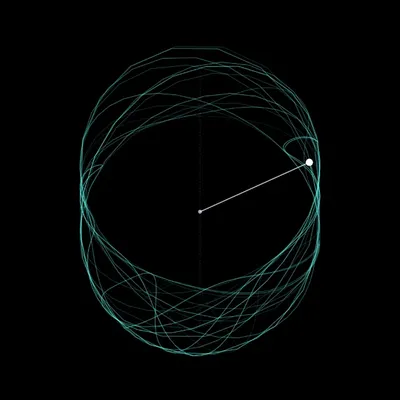
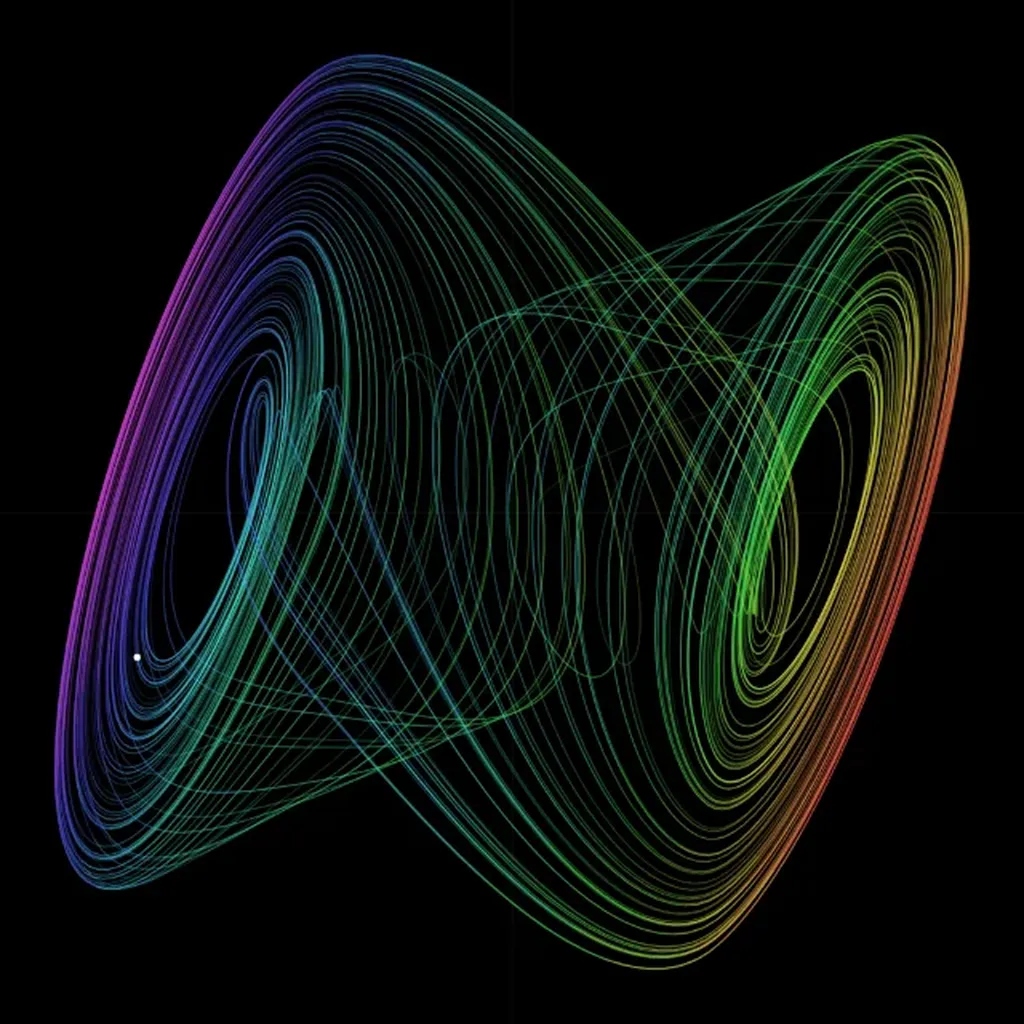
The trajectory starts at and is drawn in the plane of the two capacitor voltages, across the first capacitor horizontally and across the second vertically, both rescaled. Its color shows the rescaled inductor current , scaled to the range the trail covers, the white dot is the current state, and the current , and are printed in the corner. The view follows the trajectory, with separate scales for and : it widens at once when the orbit reaches its edge and narrows slowly when the orbit occupies less. Integration uses fourth-order Runge-Kutta by default, each step of split into four substeps, with ten steps per frame.
Double-scroll attractor: , , , . The orbit spirals outward around one of the two outer fixed points at , then crosses the middle region and continues on the other side, switching scrolls at irregular times.
Single-scroll chaos (α=8.7): and , the value of used in the early studies of the circuit. The orbit is chaotic but never crosses to the other side: it winds around the fixed point at only, the spiral Chua attractor. Its mirror image around is a second attractor, reached from starting points with negative . Above about the two merge into the double scroll.
Period-2 orbit (α=8.25): the same with , below the onset of chaos. The orbit settles on a limit cycle that closes after two turns of different size around . It is one stage of the period-doubling cascade that leads to the single scroll: at the cycle has a single turn, near 8.4 it has four, and from about 8.46 the motion is chaotic.
Wide double scroll (m₀=−1.3): , , , . Chaotic, with a larger double scroll whose outer fixed points sit at .
Governing equation
with the diode characteristic
The slope of is for and outside. Besides the origin there are fixed points at , and , which is at the default slopes. All three fixed points are unstable, and the orbit is passed back and forth around the outer two.
Parameters
α (C₂/C₁): 5 to 25, default 15.6. The ratio of the two capacitances.
β (C₂/LG²): 10 to 50, default 28. Combines the second capacitance, the inductance and the conductance of the linear resistor; it sets how fast the inductor current responds.
Inner slope m₀: to 0, default . Slope of the diode characteristic for .
Outer slope m₁: to 0, default . Slope for .
Time step dt: 0.005 to 0.05, default 0.02.