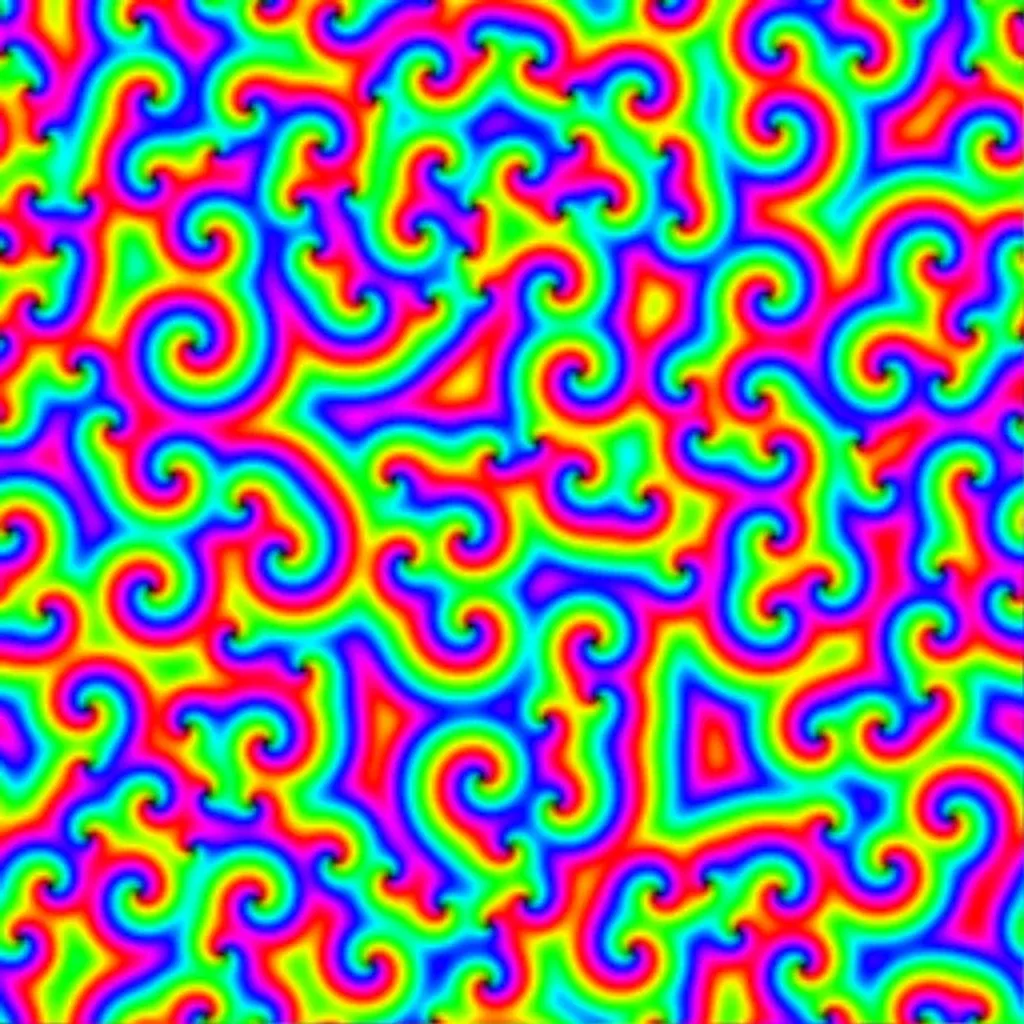
This simulation needs WebAssembly, and it could not start in this browser.
The image is a frame from a real run. Check that JavaScript is on, or try another browser.
The complex Ginzburg-Landau equation describes any extended system just past a Hopf bifurcation, the point where a steady state gives way to oscillation. Near that threshold the details of the system stop mattering: the slow changes in the amplitude and phase of the oscillation obey this one equation with two real parameters. Stewartson and Stuart derived it for fluid flows in 1971, Kuramoto and Tsuzuki for oscillating chemical reactions in 1975, and it is named after the equation Ginzburg and Landau wrote down for superconductors in 1950. In two dimensions it produces rotating spiral waves like those of the Belousov-Zhabotinsky reaction, and two kinds of turbulence: one in which only the phase is disordered, and one in which the amplitude collapses at moving defects. Aranson and Kramer (2002) review what is known about it.
What you see
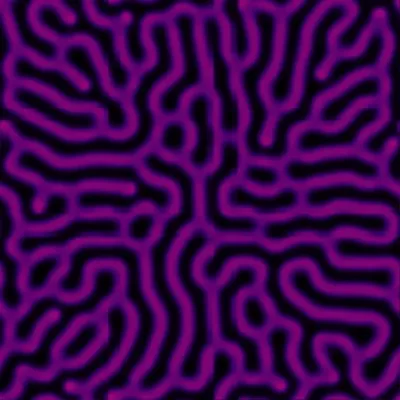
The color shows the complex field : the hue is its phase , the brightness its amplitude (full brightness from up). A defect is a point where . The phase turns by a full cycle around it, so all hues meet at a dark spot, and the lines of equal hue that leave it wind up into a spiral. Defects of opposite winding attract and annihilate in pairs.
The grid has 256 by 256 cells with spacing 1 and wraps around at the edges. Each frame advances 4 time steps of 0.05, so at 60 frames per second the simulation covers 12 time units per second. Except for Phase turbulence, every run starts with a random phase in every cell and amplitudes between 0.85 and 1.15; a reset keeps the start of the chosen preset. That start holds about 22,000 defects, and within a quarter of a second fewer than a thousand are left. The random numbers are the same each time, so a reset repeats the same run.
Governing equation
The linear term makes small amplitudes grow, the real part of the cubic term saturates them at , and couples neighbours. The parameter (linear dispersion) makes the frequency depend on the wavenumber, and (nonlinear frequency shift) makes it depend on the amplitude. Plane waves with solve the equation, and the uniform oscillation is the case . It is stable against long-wave modulations of its phase only while
the Benjamin-Feir-Newell criterion, named after Benjamin and Feir, who found the instability for water waves in 1967, and Newell, who derived it for this equation in 1974. Just beyond the line, the phase obeys the Kuramoto-Sivashinsky equation.
The Laplacian uses the five-point stencil. Time steps are explicit Euler, except that the frequency shift , a pure rotation of , is applied as a rotation that keeps exactly. The uniform oscillation then keeps and turns at frequency .
Presets
Frozen spirals: , , . The defects settle into about 130 spirals packed edge to edge and separated by shock lines where their waves collide. After about 10 seconds the cores nearly stop moving: the spirals keep turning, the amplitude pattern changes by only about 0.5% per second, and in the next two minutes the number of defects falls only from 132 to 126. Chaté and Manneville (1996) call such states frozen.
Coarsening: , . The spirals send out only weak, long waves, and pairs of opposite defects keep finding each other and annihilating. Their number falls from about 160 after 2.5 seconds to 66 after 10 seconds and 14 after one minute, leaving large regions that oscillate nearly in step.
Phase turbulence: , , , started from the uniform oscillation with a phase noise of and an amplitude noise of 1%. The Benjamin-Feir instability needs about 20 seconds to grow, then breaks the color into restless cells of slightly different phase. The amplitude stays above 0.85 and no defect appeared in two minutes of running.
Defect turbulence: , , , far beyond the line. Defects are created and annihilated all the time, between 700 and 800 at any moment, and the mean drops to 0.39.
Turbulence with 1 + bc > 0: , , . The uniform oscillation is stable here, and started from it the field stays uniform. From the random start, however, 300 to 360 defects keep moving, colliding and being reborn for as long as the run was measured, two minutes. In two dimensions this defect turbulence coexists with the stable oscillation on this side of the line.
Parameters
Linear dispersion b ( to ) and Nonlinear frequency shift c ( to ) act immediately, so a running pattern can be pushed across the line .
Time step dt: 0.005 to 0.2 (default 0.05), also immediate. Larger steps make the pattern evolve faster per frame but less accurately. The step is capped at , 80% of the stability limit of the explicit scheme, so above that value the slider has no further effect.