This simulation needs WebAssembly, and it could not start in this browser.
The image is a frame from a real run. Check that JavaScript is on, or try another browser.
Brian’s Brain is a cellular automaton devised by Brian Silverman and described by Tommaso Toffoli and Norman Margolus in their 1987 book Cellular Automata Machines. Each cell is off, firing or refractory, much like a nerve cell: after firing it has to rest for one step before it can fire again, which gives the rule its name. It is a close relative of Silverman’s Seeds rule, in which a cell is born with exactly two live neighbors and never survives. Brian’s Brain adds the refractory state, and with it nothing on the grid can stand still: activity lives on only by igniting fresh cells, so the field is always on the move, and many of its patterns are small spaceships that cross the grid at one cell per step.
What you see
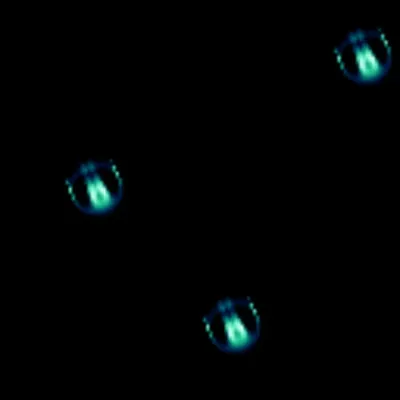
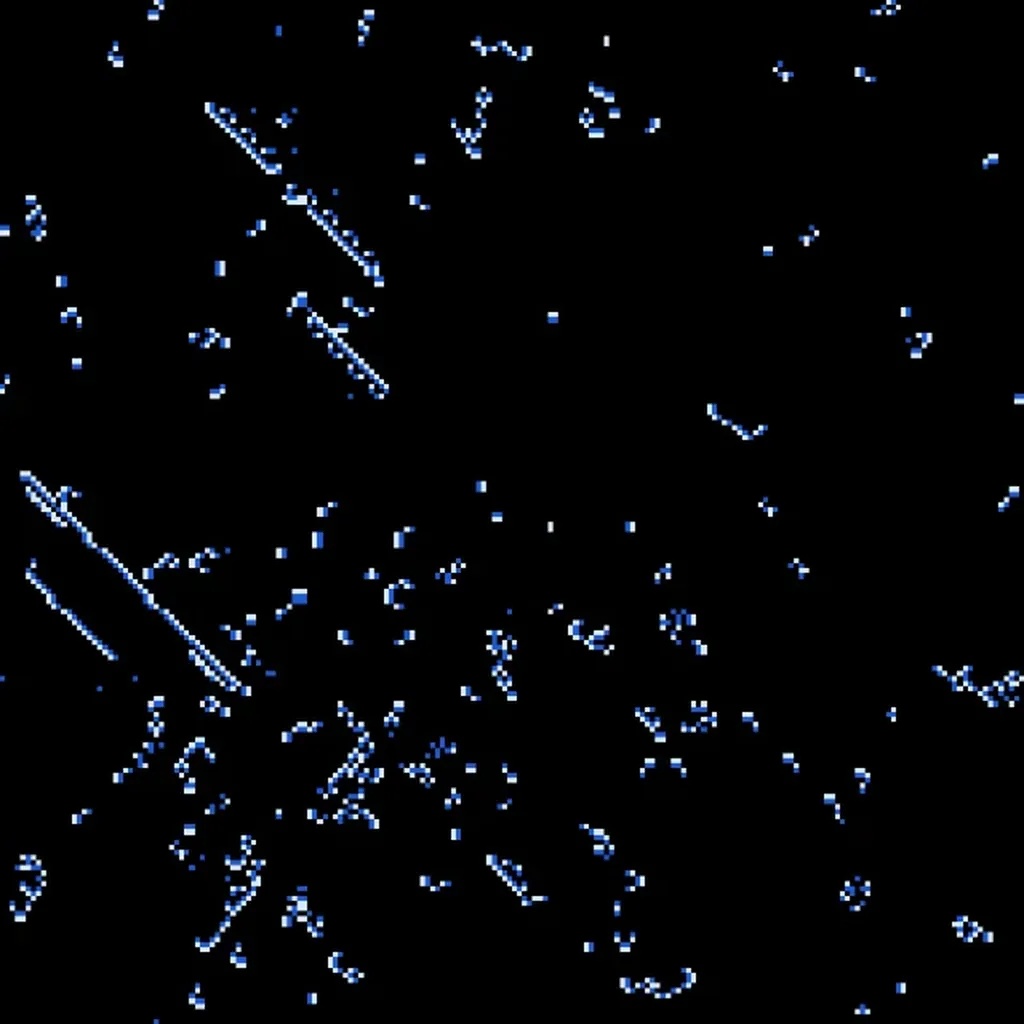
Firing cells are pale blue-white, refractory cells blue and off cells black, on a 200 by 200 grid whose edges wrap around, so the grid is a torus. Each frame is one step, 60 steps per second at 60 frames per second. The panel shows the entropy of the grid.
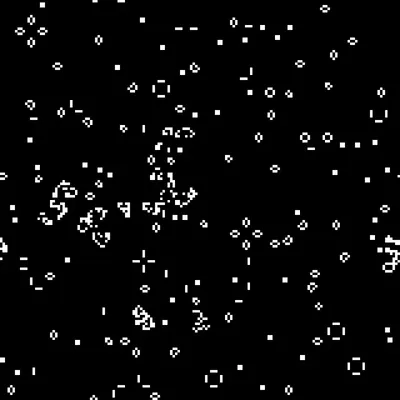
Every random start begins with a burst of activity that thins out within a few dozen steps. After about 100 steps, under two seconds, the field settles into a steady state with 2 to 3% of the cells firing and as many refractory, and it stays there: no preset died out within 20,000 steps. At any moment the grid then holds about 100 to 200 separate patterns. Typically 15 to 40 of them are the smallest spaceship, two firing cells side by side with two refractory cells behind them, which moves one cell per step. Larger structures of up to a few hundred cells form among them, and collisions destroy patterns and create new ones.
Rule
All cells update at once, each from the states of its eight neighbors (the Moore neighborhood):
In the notation for rules with refractory states this is B2/S/3: birth with two firing neighbors, no survival, three states. A cell is influenced only by its direct neighbors, so no pattern can move faster than one cell per step, and the smallest spaceship travels at exactly that limit.
Presets
Sparse start (15%): 15% of the cells start firing and the rest are off. The firing fraction falls to 9% after 10 steps and to 3.5% after 50.
Dense start (35%): the first step alone halves the firing fraction, to 17%, because most off cells have more than two firing neighbors and stay off.
Very sparse start (5%): activity first grows, to 6.5% after 10 steps, before it falls to the same steady state.
All three end in the same steady state, so the density only changes the first few seconds. The random seed is fixed, so every reset gives the same start.
Parameters
Density: the fraction of cells that start firing, 0.05 to 0.40 (default 0.15). Restart seeds the grid again with the current density. The seed is fixed, so this gives the same start as a reset, which also sets the step counter back to 0.