This simulation needs WebAssembly, and it could not start in this browser.
The image is a frame from a real run. Check that JavaScript is on, or try another browser.
About half the stars like the Sun have a companion. A planet or asteroid can orbit such a pair at a distance, circling both stars at once, but not too close: there the stars’ changing pull pumps up its orbit until it is thrown out. In 2011 the Kepler telescope found Kepler-16b, a Saturn-sized planet circling two stars every 229 days, and most of the dozen or so circumbinary planets found since orbit just outside that unstable zone.
What you see
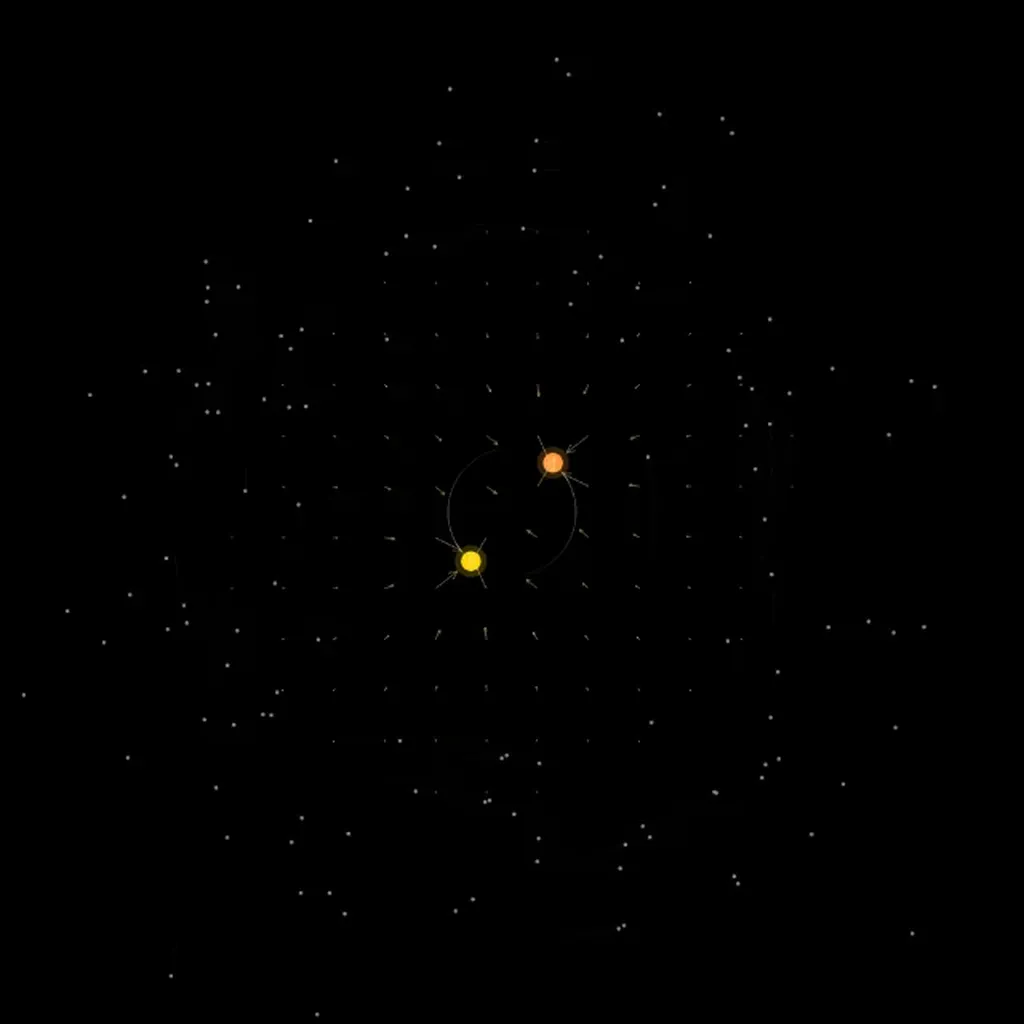
Two stars of equal mass (gold and orange) circle their common center of mass at a separation of 2, in units where and each star has mass 1, so one turn of the pair takes time units. Around them, gray asteroids start at random angles between radii 3 and 6, each at the circular speed for the combined mass of both stars, give or take 10 percent. The asteroids are massless test particles: they feel the stars but not each other, and the stars do not feel them.
Within the first ten turns of the binary most asteroids that started inside a radius of about 3.5 are flung out of the view or onto wide, eccentric orbits. Farther out the losses thin out, and beyond a radius of about 5 most asteroids stay. In one run with 500 asteroids, after 40 turns of the binary 5 percent of those starting between 3 and 4 were left, about half between 4 and 5, and 85 percent between 5 and 6.
Governing equation
integrated with leapfrog (velocity Verlet) at , eight steps per frame. The stars move on their circular orbit at angular speed for the separation .
Holman and Wiegert (1999) mapped the stable zone numerically. For two equal stars on a circular orbit, circumbinary orbits are stable beyond about , which is a radius of 4.8 here, in line with where the losses in the simulation fade out. Inside that radius the asteroids’ orbits fall into resonance with the binary and are pumped up turn after turn.
Presets
200 asteroids (standard): the default belt.
500 asteroids (dense belt): the edge of the stable zone shows more clearly.
50 asteroids (few tracers): few enough that the trails of single asteroids can be followed.
Parameters
Time step dt: the integration step, 0.0005 to 0.04 (default 0.01), and Steps per frame, 1 to 32 (default 8).
Asteroids: 50 to 500 (default 200), applies on Reset.
Rotating view ω: turns the view at this angular speed. At 0.5, the binary’s own, the two stars stand still and the asteroids move in the frame that rotates with them.
Integrator and Softening: leapfrog and by default.
The remaining controls change only the drawing.