This simulation needs WebAssembly, and it could not start in this browser.
The image is a frame from a real run. Check that JavaScript is on, or try another browser.
Seen from the side, the Aizawa attractor looks like a ball pierced by a tube along its vertical axis. A trajectory climbs the tube close to the axis, spreads outward over the top, rolls down the outside and is drawn back in near the bottom, all while turning steadily about the axis. Most of the system is symmetric under rotations about . That symmetry is the reason one small term matters so much, as the equations below show.
What you see
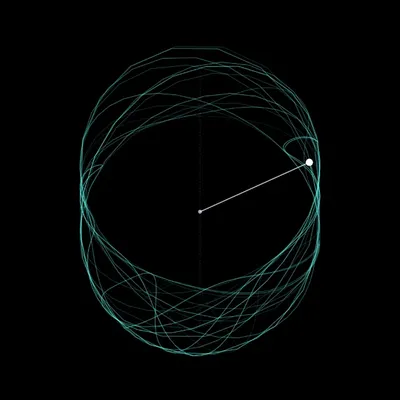
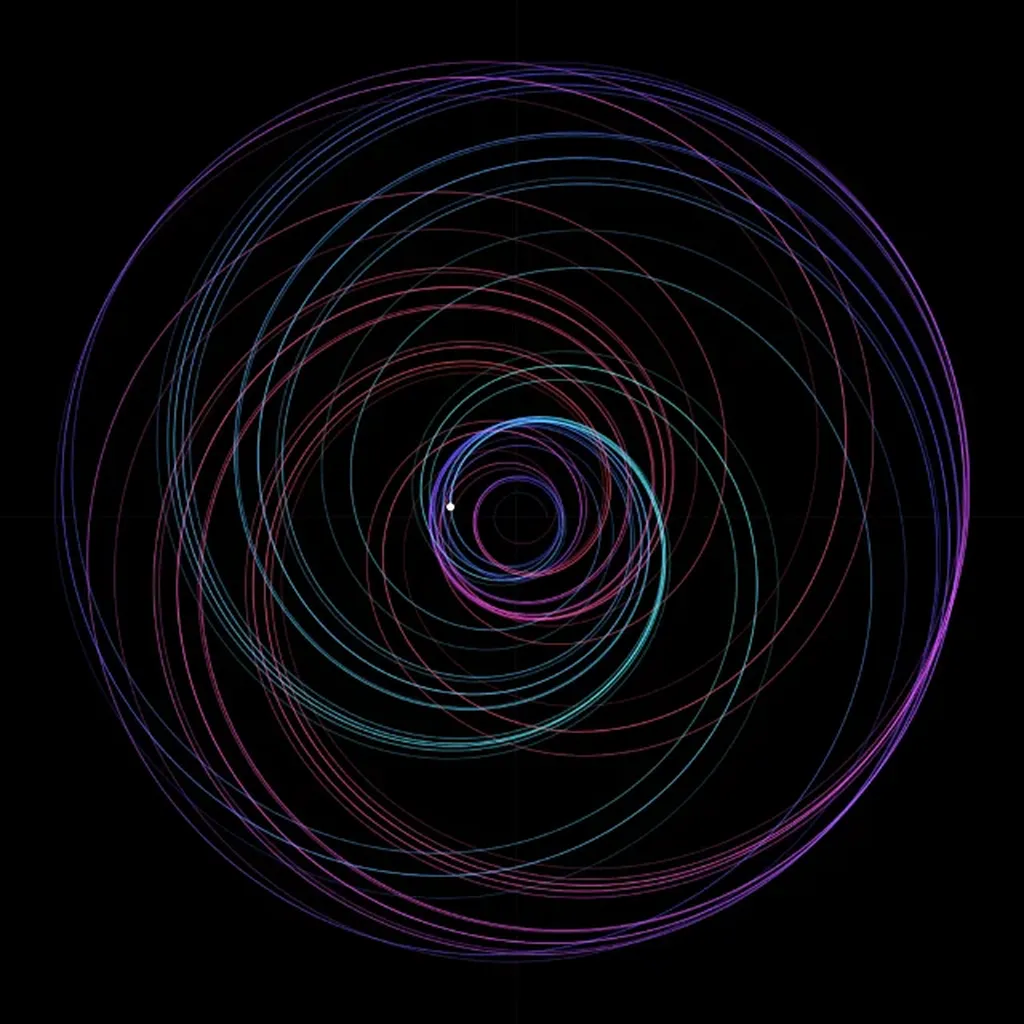
The trajectory starts at and is projected onto the x-y plane, so you look down the axis of the tube: the trail winds outward and back inward around the center. Its color shows the height , from teal (low) to red (high), scaled to the range the trail covers, the white dot is the current position, and the current is printed in the corner. The view follows the trajectory with the same scale on both axes: it widens at once when the orbit reaches its edge and narrows slowly when the orbit occupies less. Integration uses fourth-order Runge-Kutta by default, each step of split into four substeps, with eight steps per frame.
Canonical chaos: , the values usually quoted for this system. The orbit covers the ball-and-tube surface without ever closing.
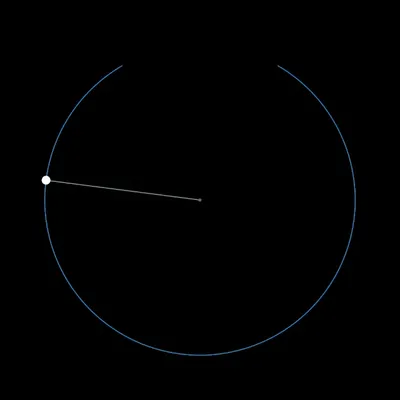
Slow spiral (d=2.5): slower rotation about the axis. With this change the motion locks into a periodic orbit.
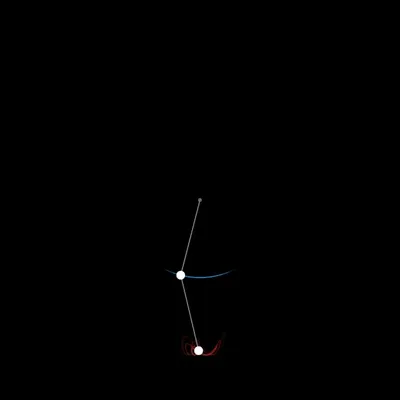
High a (a=1.2): the trajectory spirals into an equilibrium on the axis, near , and stays there.
Low forcing (c=0.3): with weaker constant drive in the trajectory also comes to rest on the axis, near .
Governing equation
In polar coordinates the first two equations become and : the orbit turns at the constant rate , and its radius grows above the height and shrinks below it. Without the last term, , the right-hand side of depends only on and . The motion would then reduce to a two-dimensional flow in plus a uniform rotation, and the Poincaré-Bendixson theorem rules out chaos in two-dimensional flows. The term depends on the angle and breaks the rotational symmetry; with the attractor cannot be strange.
Parameters
a: 0.5 to 1.5, default 0.95. Linear growth of in .
b: 0.3 to 1.2, default 0.7. The height at which the spiral switches from shrinking to growing.
c: 0.1 to 1.5, default 0.6. Constant drive in .
d: 1 to 6, default 3.5. Rotation rate about the axis.
e: 0 to 1, default 0.25. How strongly the radius feeds back on depending on height.
f: 0 to 0.5, default 0.1. Strength of the symmetry-breaking term .
Time step dt: 0.002 to 0.03, default 0.01.